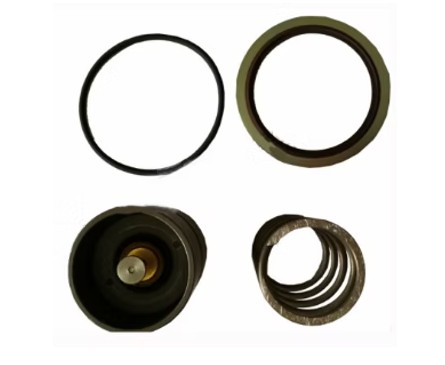
Description
Function of Thermostats
The primary function of a thermostat is to respond to temperature changes and control a connected flow path or switching function.
Depending on the compressor design, a thermostat may help to:
- Regulate lubricating-oil temperature
- Control oil flow through an oil cooler
- Maintain suitable oil viscosity
- Support rapid warm-up during compressor start-up
- Prevent excessive oil cooling
- Direct oil through the appropriate cooling path
- Support stable lubrication-system operation
- Protect temperature-sensitive components
The exact function depends on the compressor’s lubrication and cooling-system configuration.
How a Thermostat Works
A mechanical thermostat generally uses a temperature-sensitive element that changes position when the surrounding fluid reaches a predetermined temperature.
Depending on the design, this movement can open, close, or redirect a flow passage.
For example, in a lubrication system, oil may initially bypass the oil cooler while the oil is below the thermostat’s operating temperature. As the oil temperature increases, the thermostat can progressively or automatically direct more oil through the cooler.
The actual control arrangement depends on the thermostat and compressor design.
Thermostats in Compressor Oil-Cooling Systems
Thermostats are commonly associated with lubrication oil-temperature control where the compressor uses a temperature-controlled bypass arrangement.
A typical arrangement may include:
- Oil reservoir
- Main oil pump
- Thermostat or temperature-control valve
- Oil cooler
- Oil filter
- Bearing lubrication circuit
- Return line
The thermostat helps determine the proportion or route of oil passing through the cooling circuit based on temperature.
Importance of Oil Temperature Control
Lubricating oil must operate within the temperature range specified by the compressor and lubricant manufacturer.
Oil that becomes excessively hot may experience:
- Reduced viscosity
- Accelerated oxidation
- Increased degradation
- Reduced lubricating-film performance
- Increased deposit formation
Oil that remains excessively cold may also have unsuitable viscosity and flow characteristics.
A properly functioning thermostat helps the lubrication system respond to changing thermal conditions.
Types of Thermostats
The exact thermostat design depends on the compressor and lubrication system.
Mechanical Thermostats
Mechanical thermostats use a temperature-sensitive element to operate a valve or flow-control mechanism without requiring an external electrical signal.
Thermostatic Bypass Valves
These assemblies automatically direct oil through or around an oil cooler depending on temperature.
Electrically Controlled Temperature Devices
Some systems may use temperature sensors and electrically controlled valves rather than a conventional mechanical thermostat.
The replacement component should match the original compressor control arrangement.
Thermostat Construction
Depending on the design, a thermostat assembly may include:
- Valve body
- Temperature-sensitive element
- Valve element
- Spring
- Piston or actuator
- Sealing components
- Inlet and outlet ports
- Bypass passage
- Mounting components
Materials may include stainless steel, brass, alloy materials, engineered polymers, and application-specific sealing materials.
Common Thermostat Problems
Thermostats can experience mechanical or temperature-control problems during long-term operation.
Common issues include:
- Thermostat stuck open
- Thermostat stuck closed
- Incorrect temperature response
- Slow response
- Valve movement restriction
- Internal contamination
- Seal deterioration
- Corrosion
- Leakage
- Incorrect temperature setting
- Mechanical wear
A malfunctioning thermostat can affect oil temperature and therefore influence the overall lubrication system.
Thermostat Stuck Open
If a thermostat remains open to the cooling circuit when the oil is cold, the oil may be cooled more than intended.
Depending on the system design, this can contribute to:
- Slow warm-up
- Excessively low oil temperature
- Increased oil viscosity
- Altered oil flow characteristics
- Delayed achievement of the required lubrication condition
The actual effect depends on the compressor’s lubrication-system design.
Thermostat Stuck Closed
If the thermostat fails to provide the intended flow through the oil cooler when the oil temperature rises, oil temperature may increase beyond the desired operating range.
Possible causes include:
- Internal mechanical failure
- Contamination
- Blocked passages
- Incorrect assembly
- Damaged temperature-sensitive element
Other cooling-system problems should also be checked before identifying the thermostat as the sole cause.
Causes of Thermostat Failure
Contamination
Particles or degraded lubricant can interfere with the movement of internal components.
Excessive Temperature
Operation outside the thermostat’s specified temperature range can affect the sensing element or seals.
Corrosion
Unsuitable fluid conditions can cause corrosion of internal components.
Mechanical Wear
Repeated temperature cycles and mechanical movement can eventually cause component wear.
Incorrect Installation
Incorrect orientation, connections, or assembly can prevent proper operation.
Thermostat Maintenance
Thermostats generally require limited routine maintenance but should be checked during lubrication-system servicing.
Inspection may include:
- Checking oil-temperature behavior
- Inspecting for external leakage
- Checking valve movement where accessible
- Inspecting connections
- Checking for contamination
- Verifying bypass operation
- Checking the oil cooler circuit
- Testing temperature response when required
The thermostat should be inspected whenever abnormal oil-temperature behavior is observed.
Thermostat Testing
Testing can involve observing the thermostat’s response to controlled temperature changes.
Depending on the design, testing may verify:
- Opening temperature
- Closing temperature
- Valve travel
- Flow-path change
- Response consistency
- Leakage condition
Testing should be performed according to the component manufacturer’s procedure and applicable compressor maintenance requirements.
Replacement of Thermostats
A replacement thermostat must be selected according to the original compressor lubrication-system specification.
Important selection parameters include:
- Compressor manufacturer
- Compressor model
- Compressor serial number
- Existing thermostat part number
- Thermostat type
- Nominal operating temperature
- Opening temperature
- Closing temperature where applicable
- Operating pressure
- Oil type
- Oil viscosity
- Connection size
- Connection type
- Body material
- Seal material
- Mounting arrangement
- Flow direction
The thermostat’s temperature setting is particularly important and should not be selected solely based on physical dimensions.
Applications
Thermostats and thermostatic temperature-control components are used in centrifugal compressor systems across industries including:
- Manufacturing plants
- Steel plants
- Cement plants
- Power plants
- Chemical industries
- Petrochemical facilities
- Refineries
- Pharmaceutical manufacturing
- Food and beverage industries
- Automotive manufacturing
- Textile industries
- Process industries
- Industrial compressed-air plants
Thermostat Selection Specifications
| Parameter | Requirement |
|---|---|
| Component | Thermostat / Thermostatic Valve |
| Equipment | Centrifugal Air Compressor |
| Compressor Make | As per equipment |
| Compressor Model | As per equipment |
| Compressor Serial Number | As available |
| Application | Oil Temperature / Cooling Control |
| Thermostat Type | Mechanical / Thermostatic Bypass / As applicable |
| Operating Temperature | As specified |
| Opening Temperature | As specified |
| Closing Temperature | As applicable |
| Operating Pressure | As per system |
| Oil Type | As specified |
| Oil Viscosity | As specified |
| Flow Capacity | As required |
| Connection Type | Threaded / Flanged / As specified |
| Connection Size | As per system |
| Body Material | As specified |
| Seal Material | As required |
| Flow Direction | As specified |
| Application | Lubrication and temperature control |
Why Choose Aegis Projects?
Aegis Projects Technology provides industrial compressor spare parts and lubrication-system components for centrifugal air compressor applications.
Our thermostat solutions can be evaluated according to the compressor’s original oil-cooling arrangement, temperature requirements, connection configuration, operating pressure, lubricant specification, and control philosophy.
We support requirements for:
- Compressor oil thermostats
- Thermostatic bypass valves
- Oil-temperature control components
- Lubrication-system thermostats
- Replacement thermostat assemblies
- Thermostatic valve components
- Compressor lubrication-system spares
- Replacement and retrofit requirements
For accurate identification, share the compressor make, model, serial number, existing thermostat part number, photographs, temperature setting, connection dimensions, oil specification, or drawings wherever available.
Request a Quote
Looking for a thermostat for a centrifugal air compressor lubrication system?
Contact Aegis Projects Technology Pvt. Ltd. with your compressor and thermostat details. Our team can assist with identifying a suitable replacement thermostat or temperature-control assembly for your compressor application.