Description
Function of a Thermostatic Expansion Valve
The TXV performs several important functions within a refrigeration circuit:
- Regulates refrigerant flow into the evaporator
- Controls evaporator superheat
- Matches refrigerant flow to the cooling load
- Helps maintain efficient evaporator utilization
- Prevents excessive liquid refrigerant from returning to the compressor
- Supports stable refrigeration-system operation
- Helps maintain appropriate evaporator operating conditions
How a Thermostatic Expansion Valve Works
A TXV responds primarily to the temperature and pressure conditions at the evaporator outlet.
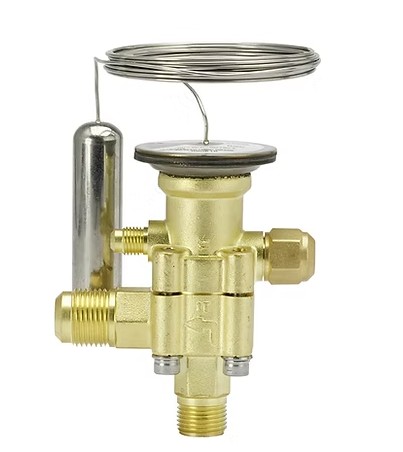
A typical thermostatic expansion valve consists of a sensing bulb, diaphragm, spring mechanism, and valve assembly.
The sensing bulb is installed at the evaporator outlet and responds to refrigerant temperature. The pressure generated by the sensing bulb acts on the diaphragm. This force is balanced against evaporator pressure and the adjustable spring force.
The resulting movement of the valve controls the opening through which liquid refrigerant enters the evaporator.
This allows the TXV to regulate refrigerant flow according to changing evaporator load conditions.
Main Components of a TXV
Depending on the design, a thermostatic expansion valve may include:
- Valve body
- Orifice
- Valve seat
- Valve pin
- Diaphragm
- Sensing bulb
- Capillary tube
- Spring
- Superheat adjustment mechanism
- Inlet and outlet connections
- Equalizer connection
- Internal seals and components
The exact construction varies according to valve design, refrigerant, capacity, connection type, and application.
External and Internal Equalization
TXVs may use either internal or external pressure equalization, depending on the system and evaporator pressure-drop requirements.
Internally Equalized TXV
An internally equalized valve uses the pressure at the valve outlet internally to influence valve operation.
Externally Equalized TXV
An externally equalized valve uses a separate equalizer connection to sense evaporator pressure at the appropriate location.
External equalization can be important in systems where the evaporator and associated piping create a significant pressure drop.
The correct equalization arrangement should be selected according to the refrigeration-system design.
Types of Thermostatic Expansion Valves
Fixed-Orifice TXV
Designed with a defined flow configuration for specific operating requirements.
Adjustable TXV
Allows superheat adjustment within the valve’s specified operating range.
Externally Equalized TXV
Uses an external pressure connection to account for evaporator pressure drop.
Internally Equalized TXV
Uses internal pressure equalization within the valve assembly.
Interchangeable-Orifice TXV
Some valve designs use replaceable or interchangeable orifices to accommodate different refrigeration capacities and operating conditions.
Refrigerant Compatibility
TXV selection must take into account the refrigerant used in the refrigeration system.
The valve, sensing charge, seals, materials, and internal components must be compatible with the specified refrigerant and operating conditions.
Common refrigeration-system refrigerants vary by application, equipment design, and regulatory requirements. Therefore, the replacement valve should be selected according to the original equipment specification and refrigerant requirement, rather than simply matching physical dimensions.
Applications
Thermostatic expansion valves are used in:
- Cold rooms
- Cold storage systems
- Commercial refrigerators
- Industrial refrigeration systems
- Freezers
- Display cabinets
- Chillers
- Air-conditioning systems
- Food processing refrigeration
- Beverage refrigeration
- Process cooling systems
- Industrial cooling equipment
- HVAC-R systems
Common TXV Problems
Incorrect Superheat
Incorrect superheat can result from improper valve adjustment, incorrect valve selection, sensor problems, refrigerant-charge conditions, or system operating issues.
Valve Stuck Closed or Restricted
A restricted TXV can reduce refrigerant flow into the evaporator and affect cooling performance.
Possible causes include:
- Contamination
- Moisture or ice formation
- Debris
- Damaged internal components
- Blocked inlet strainer
- Incorrect installation
Valve Overfeeding
Excessive refrigerant flow can occur due to incorrect valve selection, improper adjustment, sensing-bulb problems, or other system conditions.
Damaged Sensing Bulb
A poorly installed, damaged, or incorrectly positioned sensing bulb can result in improper valve operation.
Refrigerant Leakage
Leakage may occur at connections, seals, joints, or other valve components due to installation problems, corrosion, mechanical damage, or component deterioration.
Installation Considerations
Correct installation is important for reliable TXV operation.
Important considerations include:
- Install the valve in the correct refrigerant-flow direction
- Select the correct valve and orifice capacity
- Use the correct refrigerant-compatible valve
- Install the sensing bulb at the recommended evaporator outlet location
- Secure the sensing bulb properly
- Protect the sensing bulb from unwanted heat sources
- Connect the external equalizer correctly where required
- Keep the refrigeration circuit clean
- Follow the manufacturer’s installation and adjustment procedure
The sensing bulb position and installation method can significantly affect superheat control.
Inspection & Maintenance
TXVs generally require limited routine maintenance when the refrigeration system is operating correctly, but inspection is important during troubleshooting or servicing.
Checks may include:
- Inspect valve body and connections for leakage
- Check sensing-bulb condition and mounting
- Inspect capillary tube for damage
- Check refrigerant flow conditions
- Measure evaporator superheat
- Inspect inlet strainers where provided
- Check for contamination or restriction
- Verify equalizer connection where applicable
- Check valve adjustment
- Inspect insulation around the sensing bulb where required
- Replace damaged seals or components as specified
Thermostatic Expansion Valve Selection Parameters
| Parameter | Requirement |
|---|---|
| Refrigeration Equipment | Cold room / freezer / chiller / HVAC-R / other |
| Refrigerant | As specified by system |
| Valve Type | TXV |
| Equalization | Internal / external |
| Refrigeration Capacity | Application-specific |
| Evaporating Temperature | Application-specific |
| Condensing Temperature | Application-specific |
| Superheat Range | According to application |
| Valve Capacity | Based on operating conditions |
| Orifice Size | As required |
| Sensing Charge | Compatible with application |
| Inlet Connection | Required size/type |
| Outlet Connection | Required size/type |
| Equalizer Connection | Where applicable |
| Operating Pressure | System-specific |
| Temperature Range | Application-specific |
| Material | Compatible with refrigerant and system |
| Manufacturer / Part Number | As specified |
Why Choose Aegis Projects?
Aegis Projects Technology supplies thermostatic expansion valves and refrigeration control components for commercial, industrial, and HVAC-R applications.
We can assist with selecting replacement TXVs based on:
- Original valve part number
- Refrigeration equipment model
- Refrigerant type
- Refrigeration capacity
- Evaporating temperature
- Condensing conditions
- Valve and orifice configuration
- Internal or external equalization
- Connection size
- Sensing-bulb requirements
Correct TXV selection is essential for achieving appropriate refrigerant flow and evaporator superheat control.
Contact Aegis Projects Technology for thermostatic expansion valves and other refrigeration spare parts.