Description
How a Tepid Water System Works
A typical tepid water skid operates as a centralized warm-water supply and circulation system.
- Potable water enters the packaged skid.
- Water is stored in a stainless-steel storage tank.
- A heating system raises or maintains the water at the required temperature.
- Circulation pumps continuously circulate the conditioned water through the emergency safety-water network.
- Temperature and pressure are monitored throughout the system.
- UV treatment can be incorporated to help control bacterial growth in the circulating water.
- The system supplies conditioned water to connected emergency showers and eyewash stations.
The system can be configured for different plant sizes and demand requirements.
Emergency Safety Shower & Eyewash Water Supply
Emergency showers and eyewash stations are critical safety equipment in facilities where personnel may be exposed to hazardous chemicals or other harmful substances.
A centralized tepid water system helps provide a controlled supply of warm water to these emergency stations.
The supplied source material references ANSI Z358.1-2014 and states a tepid-water delivery range of 60°F to 100°F for emergency shower and eyewash applications.
Project-specific compliance requirements should be reviewed against the applicable current standards, local regulations and site requirements during engineering.
Tepid Water System Capacity
The system capacity should be determined according to the number and arrangement of emergency shower and eyewash stations connected to the circuit.
The supplied design basis specifies that tepid water equipment must be capable of delivering:
20 GPM for 15 minutes at each shower/eyewash station.
Final tank and pump sizing should consider:
- Number of shower stations
- Number of eyewash stations
- Number of stations that could operate simultaneously
- Total circuit demand
- Piping length
- Elevation differences
- Pressure drop
- Required operating pressure
- Required water temperature
- Site-specific installation conditions
This engineering approach allows the system to be sized according to the actual emergency water demand of the facility.
Tepid Water Skid Components
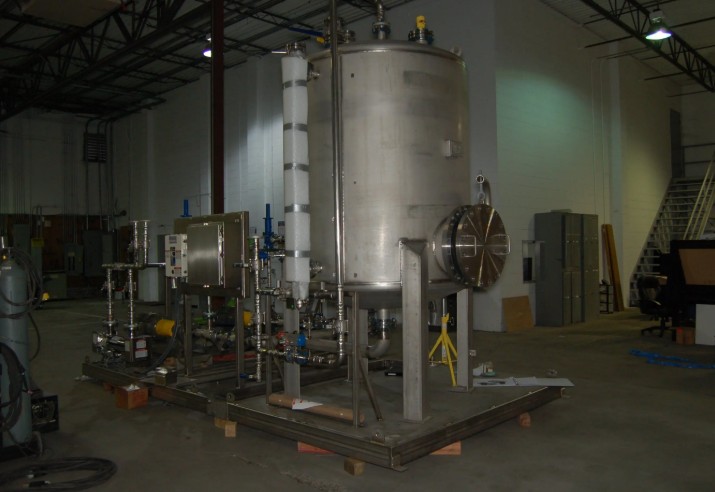
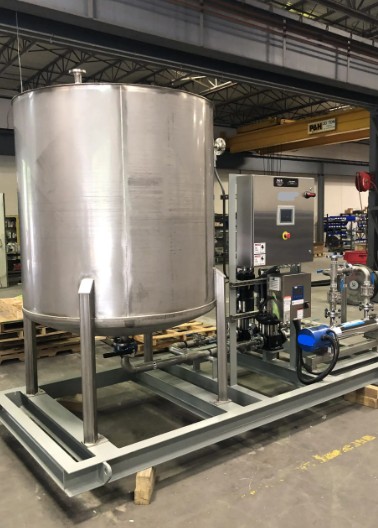
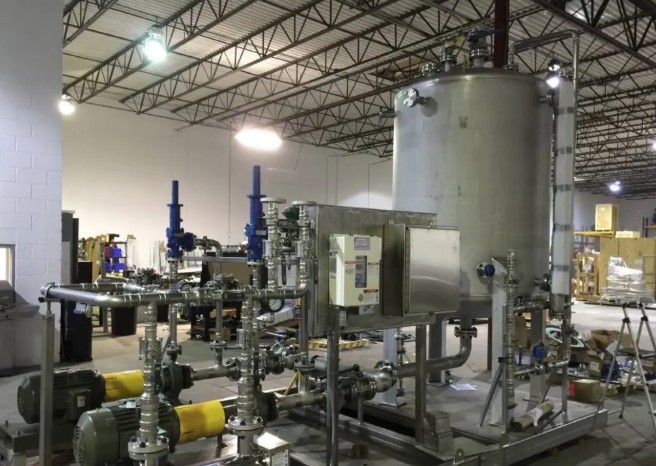
A typical Aegis Projects tepid water skid can incorporate:
Stainless Steel Tepid Water Storage Tank
A custom stainless-steel tank provides storage for the conditioned potable water.
Tank capacity is selected according to the required emergency-water demand and system configuration.
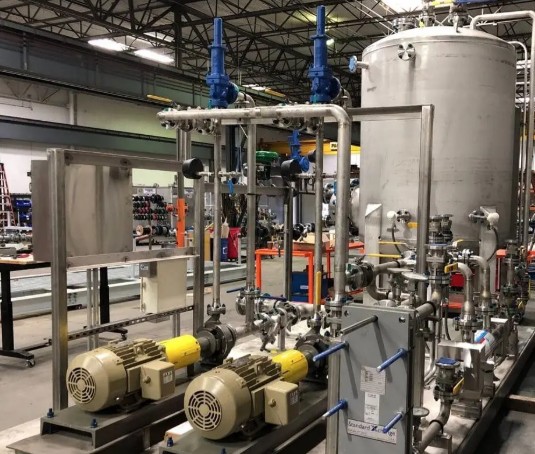
Heat Exchanger
A heat exchanger can be incorporated to transfer heat into the stored water and maintain the required temperature.
Steam-heated configurations can be provided where suitable steam utilities are available.
Centrifugal Pumps
Two centrifugal pumps can be incorporated to provide continuous circulation and system redundancy, subject to the project design.
UV Sterilization
A UV sterilizer can be included to help control bacterial growth within the circulating water system.
Control Valves
Manual and automated control valves can be used for flow regulation, isolation and temperature control.
Pressure Relief Valves
Pressure relief equipment provides protection against excessive system pressure where required.
Level & Pressure Instrumentation
The skid can incorporate tank level measurement, pressure switches, pressure gauges and associated instrumentation.
Temperature Instrumentation
Temperature sensors and gauges can monitor water temperature throughout the system.
Stainless Steel Piping
Corrosion-resistant stainless-steel piping and fittings can be used throughout the water circuit according to project requirements.
Local Control Panel
A dedicated control panel can provide centralized monitoring and control of pumps, heating equipment, UV treatment and other system functions.
Typical Tepid Water System Components
| Component | Function |
|---|---|
| Stainless Steel Storage Tank | Stores conditioned potable water |
| Heat Exchanger | Transfers heat into the water |
| Centrifugal Pumps | Circulate water through the facility |
| UV Sterilizer | Helps control bacterial growth |
| Control Valves | Regulate and isolate water flow |
| Pressure Relief Valves | Protect against excessive pressure |
| Level Transmitter | Monitors tank water level |
| Pressure Gauges | Monitor system pressure |
| Temperature Gauges | Monitor water temperature |
| Temperature Sensors | Provide temperature feedback |
| Stainless Steel Piping | Provides corrosion-resistant water distribution |
| Control Panel | Centralized system control |
| PLC/HMI | Automated monitoring and operation |
The final equipment selection depends on the site requirements and project specification.
Tepid Water System Options
Aegis Projects tepid water skids can be configured with various heating, treatment and control options.
Immersion Heaters
Electric immersion heaters can be incorporated where electrical heating is preferred and suitable for the application.
Heat Exchangers
Heat exchangers can be used to heat the stored water using an external heating medium.
Steam Heating
Steam-based heating arrangements can be provided where a suitable steam supply is available.
UV Disinfection
UV treatment can be incorporated to help control bacterial growth within the circulating water.
Automation & Controls
PLC-based controls and HMI interfaces can be incorporated for centralized monitoring and automated operation.
Freeze Protection
Freeze-protection provisions can be considered for installations exposed to low ambient temperatures.
Water Storage Tanks
Tank capacity can be customized according to the number of emergency stations and expected simultaneous demand.
Automated Controls & Monitoring
The tepid water skid can be equipped with an integrated control system for monitoring and controlling critical operating parameters.
Depending on the project requirements, the automation system can monitor:
- Tank water level
- Water temperature
- System pressure
- Pump status
- Heating system status
- UV system status
- Valve status
- Alarm conditions
- Equipment faults
PLC and HMI systems can provide operators with centralized control and status information.
The system can also be designed for integration with existing plant automation where required.
Engineering & System Sizing
Proper sizing of a tepid water system requires consideration of the complete emergency-water distribution network.
Aegis Projects can consider:
- Number of emergency showers
- Number of eyewash stations
- Simultaneous-use requirements
- Required flow rate
- Required duration
- Storage capacity
- Pump capacity
- Piping length
- Pipe diameter
- Elevation
- Pressure losses
- Required water temperature
- Heating capacity
- Site ambient conditions
- Water quality requirements
The final system configuration is determined through application-specific engineering.
Safety & Compliance Considerations
Tepid water systems for emergency showers and eyewash stations are safety-critical systems. The design should therefore consider applicable standards, regulations and site requirements.
The supplied source specifically references:
- ANSI Z358.1
- NSF requirements where applicable
- Uniform Plumbing Code (UPC)
- International Plumbing Code (IPC)
- Applicable local requirements
The exact standards applicable to a project depend on the installation location, facility type and governing authority.
The emergency shower and eyewash equipment itself should also be inspected, tested and maintained according to the applicable requirements and facility procedures.
Testing & Maintenance
Providing a tepid water skid is only one part of an emergency safety-water system.
Emergency shower and eyewash stations require regular inspection and testing to verify that they remain available when required.
The supplied source references weekly activation and annual evaluation under ANSI Z358.1-2014. Actual inspection and testing procedures should follow the applicable current standard, equipment manufacturer’s requirements and site safety procedures.
Facilities with large numbers of emergency stations may also benefit from:
- Regular inspection programs
- Site personnel training
- Emergency equipment mapping
- Maintenance records
- Recurring operator training
- Periodic system performance checks
Stainless Steel Construction
Because tepid water systems are intended for potable water and emergency safety applications, corrosion-resistant materials can be selected for the water-contacting components.
Depending on the application, the system may incorporate:
- Stainless steel storage tank
- Stainless steel pumps or wetted components
- Stainless steel valves
- Stainless steel piping
- Stainless steel fittings
- Stainless steel skid frame
- Corrosion-resistant instrumentation
Material selection should be confirmed based on water quality, temperature, pressure and applicable project requirements.
Factory Assembly & Testing
Tepid water skid packages can be factory assembled and tested before delivery.
Testing may include:
- Pump operation
- Heating operation
- Temperature control
- Tank level monitoring
- Pressure monitoring
- Valve operation
- UV system operation
- PLC functionality
- HMI operation
- Alarm functions
- Control sequences
Factory Acceptance Testing (FAT) can be arranged according to the agreed project requirements.
Applications
Tepid Water Systems are particularly suitable for industrial facilities requiring centralized emergency water supply systems, including:
- Chemical Plants
- Petrochemical Facilities
- Oil & Gas Facilities
- Pharmaceutical Plants
- Manufacturing Facilities
- Process Industries
- Refineries
- Power & Energy Facilities
- Industrial Laboratories
- Water Treatment Facilities
- Hazardous Chemical Handling Areas
Benefits of Aegis Projects Tepid Water Systems
Controlled Water Temperature
Designed to provide a controlled warm-water supply to emergency safety equipment.
Centralized System
A single packaged system can supply multiple emergency shower and eyewash stations.
Continuous Circulation
Continuous water circulation helps maintain the desired system conditions throughout the distribution network.
UV Treatment Option
UV sterilization can be incorporated to help control bacterial growth.
Custom Sizing
Tank, pump and heating capacity can be engineered according to the number of stations and expected simultaneous demand.
Automated Monitoring
PLC and HMI controls can provide centralized monitoring of temperature, pressure, level and equipment status.
Skid-Mounted Design
Major equipment can be integrated into a compact, organized skid package.
Custom Heating Options
Immersion heating, heat exchanger and steam heating options can be considered according to site utilities and project requirements.
Tepid Water Skids by Aegis Projects Technology
Aegis Projects Technology Pvt. Ltd. provides engineered packaged systems for industrial pumping, heat transfer, process cooling, automation and emergency safety-water applications.
Our Tepid Water Systems are designed to provide a controlled supply of warm potable water to emergency safety showers and eyewash stations across industrial facilities.
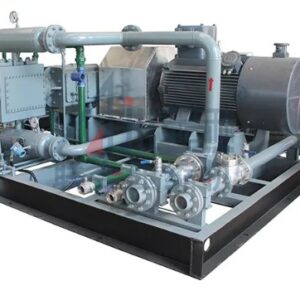
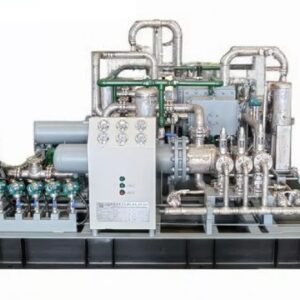
The complete package can integrate stainless-steel storage, circulation pumps, heat exchangers, UV treatment, valves, instrumentation, heating equipment and automation controls into a single skid-mounted system.
Request a Customized Tepid Water System
Contact Aegis Projects Technology with the number of emergency showers and eyewash stations, expected simultaneous demand, required water temperature, site piping information and available heating utilities to discuss a customized tepid water skid.
Final tank capacity, pump sizing, heating duty, flow requirements, materials, temperature range, controls and applicable safety standards are subject to application-specific engineering and current project requirements.