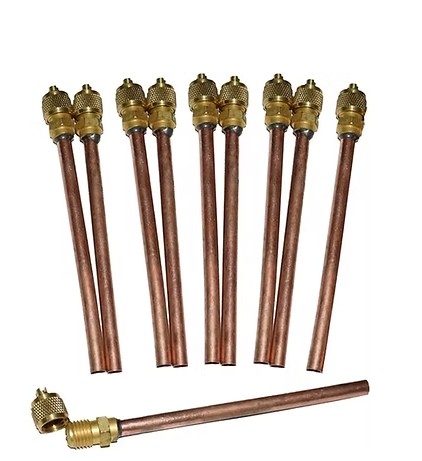
Description
Refrigeration Pipe and Accessory Functions
Refrigeration piping and accessories are used for:
- Connecting refrigeration components
- Carrying refrigerant between system components
- Routing suction, discharge, and liquid lines
- Connecting compressors, condensers, evaporators, and expansion devices
- Providing service and isolation points
- Supporting and securing refrigeration piping
- Creating directional changes in pipe runs
- Joining different pipe sections
- Providing suitable connections for equipment
- Reducing or increasing pipe size where required
- Supporting system maintenance and servicing
Typical Refrigeration Piping Arrangement
A typical refrigeration system may include several different piping circuits:
Compressor → Discharge Line → Condenser → Liquid Line → Expansion Device → Evaporator → Suction Line → Compressor
The pipe material, diameter, wall thickness, connection method, insulation, and installation arrangement must be selected according to the refrigeration system and operating conditions.
Types of Refrigeration Pipes
1. Copper Refrigeration Pipes
Copper tubing is widely used in refrigeration and HVAC-R systems because of its suitability for many refrigeration applications and its compatibility with common joining methods.
Copper pipes can be used for:
- Liquid lines
- Suction lines
- Discharge lines
- Condenser connections
- Evaporator connections
- Equipment interconnections
The appropriate copper tube specification should be selected according to the refrigerant, pressure, temperature, and applicable installation requirements.
2. Stainless Steel Pipes and Tubes
Stainless steel piping may be used where specific pressure, temperature, corrosion-resistance, cleanliness, or application requirements call for it.
3. Special Application Piping
Certain refrigeration systems may require piping materials or configurations specifically approved for particular refrigerants, pressures, temperatures, or industrial processes.
The piping material must always be compatible with the refrigerant and operating conditions.
Refrigeration Pipe Accessories
A refrigeration installation may require a wide range of accessories, including:
- Elbows
- Tees
- Reducers
- Couplings
- Adapters
- Unions
- Flare fittings
- Brazed fittings
- Solder/brazed connections where applicable
- Pipe clamps
- Pipe supports
- Mounting brackets
- Service connections
- Charging connections
- Access fittings
- Vibration-isolation components
- Flexible connectors where required
- Pipe insulation accessories
- Sealing components
The actual accessories required depend on the equipment layout and piping design.
Refrigeration Elbows
Elbows are used to change the direction of refrigeration piping.
Common configurations include:
- 45° elbows
- 90° elbows
- Long-radius elbows
- Short-radius elbows
- Different connection configurations
Correct elbow selection can help achieve the required piping arrangement while maintaining suitable flow characteristics.
Tees and Branch Fittings
Tees are used to create a branch connection from a main refrigeration pipe.
They may be used in:
- Multiple evaporator systems
- Parallel refrigeration circuits
- Branch liquid lines
- Suction piping
- Process-cooling systems
Branch piping should be designed according to refrigerant flow, oil return, pressure drop, and system operating conditions.
Reducers and Adapters
Reducers are used to connect pipes with different diameters.
Adapters can provide transitions between different connection types or equipment interfaces.
Selection should consider:
- Pipe size
- Connection type
- Refrigerant compatibility
- Pressure rating
- Temperature range
- Material compatibility
Flare Fittings
Flare fittings provide detachable mechanical connections and can be used in suitable refrigeration installations.
They may be useful for:
- Service connections
- Equipment connections
- Smaller refrigeration systems
- Maintenance-access points
The fitting type and size must match the corresponding tubing and equipment connection.
Pipe Supports and Clamps
Proper support is important for maintaining the mechanical stability of refrigeration piping.
Pipe supports can help:
- Prevent excessive vibration
- Maintain pipe alignment
- Reduce mechanical stress on equipment connections
- Support long pipe runs
- Prevent unwanted movement
- Maintain insulation integrity
Support spacing should be determined according to pipe size, material, installation conditions, and applicable requirements.
Refrigeration Service Accessories
Refrigeration systems may require additional service accessories for commissioning and maintenance.
These can include:
- Service ports
- Access fittings
- Charging connections
- Isolation valves
- Service valves
- Pressure-test connections
- Vacuum connections
- Refrigerant charging accessories
These components provide technicians with appropriate access for testing, evacuation, charging, and maintenance.
Pipe Insulation Accessories
Proper insulation is particularly important for refrigeration suction lines and cold surfaces.
Insulation accessories can include:
- Insulation sleeves
- Insulation tape
- Joining adhesives
- Vapour-barrier materials
- Protective coverings
- Clamps and fastening accessories
The insulation system should be selected according to the pipe temperature, ambient conditions, moisture exposure, and application.
Applications
Refrigeration pipes and accessories are used in:
- Commercial refrigeration
- Industrial refrigeration
- Cold rooms
- Cold storage facilities
- Freezer rooms
- Supermarket refrigeration
- Refrigerated display cabinets
- Food and beverage refrigeration
- Pharmaceutical refrigeration
- Chillers
- HVAC-R systems
- Process cooling
- Ice-making systems
- Industrial cooling plants
- Temperature-controlled warehouses
- Cold-chain facilities
Importance of Correct Pipe Selection
Incorrect piping can affect refrigeration system performance.
Important considerations include:
- Refrigerant velocity
- Pressure drop
- Oil return
- Pipe diameter
- Pipe length
- Vertical lift
- Refrigerant type
- Operating pressure
- Operating temperature
- Installation arrangement
- Insulation
- Number of bends and fittings
Piping should therefore be designed according to the complete refrigeration system rather than selected solely by nominal pipe size.
Common Refrigeration Piping Problems
Problems with refrigeration piping and accessories can include:
- Refrigerant leakage
- Excessive pressure drop
- Incorrect pipe sizing
- Poor brazed joints
- Loose connections
- Pipe vibration
- Mechanical stress
- Damaged insulation
- Condensation on cold piping
- Corrosion
- Blocked or restricted piping
- Poor oil return
- Excessive bends or unnecessary fittings
- Incorrect pipe routing
These problems can contribute to reduced refrigeration performance and increased maintenance requirements.
Inspection and Maintenance
Routine inspection of refrigeration piping can include:
- Checking joints and connections for leakage
- Inspecting pipe supports
- Checking insulation condition
- Inspecting for corrosion
- Checking vibration
- Inspecting pipe alignment
- Checking for mechanical damage
- Monitoring operating pressures
- Checking for abnormal temperature differences
- Inspecting service connections
- Checking valves and fittings
- Looking for signs of oil around suspected refrigerant leaks
Any refrigerant leak should be investigated and repaired according to appropriate safety and service procedures.
Installation Considerations
Correct installation is important for reliable refrigeration operation.
Consider the following:
- Select piping compatible with the refrigerant.
- Use suitable pressure-rated components.
- Confirm pipe diameter according to system design.
- Keep the refrigeration circuit clean.
- Prevent moisture and contaminants from entering open piping.
- Use appropriate joining methods.
- Support piping adequately.
- Minimize unnecessary bends and fittings.
- Protect piping from mechanical damage.
- Provide suitable insulation for cold lines.
- Allow for thermal movement where required.
- Check all joints for leakage after installation.
- Follow the equipment and piping manufacturer’s requirements.
Pipe and Accessory Selection
The correct piping components should be selected according to the complete refrigeration system.
| Specification | Requirement |
|---|---|
| Application | Refrigeration / HVAC-R / Chiller / Cold Storage |
| Pipe Type | Copper / Stainless Steel / Application Specific |
| Refrigerant | Application Specific |
| Pipe Size | According to System Design |
| Pipe Length | According to Installation |
| Operating Pressure | According to Refrigeration System |
| Operating Temperature | Application Specific |
| Connection Type | Brazed / Flare / Threaded / Other |
| Fitting Type | Elbow / Tee / Reducer / Coupling / Adapter |
| Material | According to Refrigerant and Application |
| Wall Thickness | According to Pressure and Application |
| Insulation | According to Operating Temperature |
| Pipe Support | Clamp / Bracket / Hanger / Application Specific |
| Service Connection | As Required |
| Flow Direction | According to System Design |
| Installation Environment | Indoor / Outdoor / Industrial / Refrigerated |
| Manufacturer / Part Number | As Required |
Replacement Considerations
When replacing refrigeration pipes or accessories, the replacement should be selected based on the original component’s application and operating requirements.
Verify:
- Refrigerant compatibility
- Pipe diameter
- Wall thickness
- Pressure rating
- Temperature rating
- Material
- Connection type
- Fitting dimensions
- Installation location
- Insulation requirements
- Manufacturer or part number where applicable
Using an unsuitable fitting or pipe can result in leakage, excessive pressure drop, mechanical failure, or poor refrigeration performance.
Pipe and Refrigeration Accessories Supplier – Aegis Projects
Aegis Projects Technology Pvt. Ltd. supplies refrigeration piping components and accessories for commercial, industrial, and process-cooling applications.
Our refrigeration range includes pipes, fittings, elbows, tees, reducers, adapters, service accessories, pipe supports, valves, expansion devices, temperature sensors, pressure switches, heat exchangers, compressors, and other refrigeration components.
Pipe and accessories can be selected according to the refrigerant, pipe size, operating pressure, temperature, connection method, installation configuration, and application requirements.
Contact Aegis Projects for refrigeration pipes and other accessories suitable for your refrigeration system installation, maintenance, or replacement requirements.