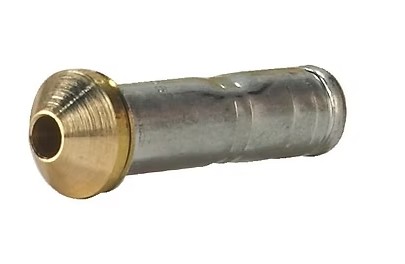
Description
Function of the Expansion Valve Orifice
The orifice provides the calibrated opening through which liquid refrigerant passes into the evaporator.
Its main functions include:
- Regulating the available refrigerant flow capacity
- Providing controlled expansion of liquid refrigerant
- Matching refrigerant flow to the required cooling capacity
- Supporting proper evaporator operation
- Working with the thermostatic expansion valve to control refrigerant feed
- Maintaining appropriate refrigerant distribution according to system conditions
The orifice should be selected to match the specific expansion valve body and refrigeration application.
How the Orifice Works
Liquid refrigerant enters the expansion valve and passes through the calibrated orifice. The restriction creates the pressure drop required for the refrigerant to expand before entering the evaporator.
The thermostatic expansion valve responds to evaporator conditions and modulates the valve opening. The installed orifice determines the flow capacity available through the valve assembly.
Therefore, both the TXV body and orifice selection are important when establishing the required refrigerant flow.
Orifice for T/TE2 Expansion Valves
T/TE2 expansion valve systems may use replaceable orifice arrangements depending on the specific valve configuration.
A replacement orifice should not be selected solely by physical appearance. The correct part should be matched using the applicable:
- Valve type
- Valve body
- Orifice designation
- Refrigerant
- Refrigeration capacity
- Evaporating temperature
- Condensing conditions
- Application requirements
- Manufacturer specification
Using an incorrectly sized orifice can affect evaporator performance and system operation.
Construction
Expansion valve orifices are precision-manufactured components designed to provide a controlled refrigerant passage.
Typical features may include:
- Precision-machined body
- Calibrated flow passage
- Valve-seat interface
- Sealing surfaces
- Corrosion-resistant construction
- Dimensional accuracy for correct valve-body installation
The exact material and construction depend on the applicable valve series and manufacturer specification.
Applications
Orifices for T/TE2 expansion valves can be used in refrigeration equipment such as:
- Commercial refrigeration systems
- Cold rooms
- Cold storage equipment
- Freezers
- Refrigerated display cabinets
- Food and beverage refrigeration
- Chillers
- HVAC-R systems
- Process cooling equipment
- Industrial refrigeration systems
Importance of Correct Orifice Selection
The orifice directly influences the refrigerant flow capacity of the expansion valve assembly.
Oversized Orifice
An orifice that is not suitable for the application may allow excessive refrigerant flow under certain operating conditions. This can contribute to unstable evaporator operation or improper superheat control.
Undersized Orifice
An undersized orifice can restrict refrigerant flow and may prevent the evaporator from receiving the required refrigerant quantity for the cooling load.
Incorrect Refrigerant Compatibility
The required flow characteristics depend on refrigerant type and operating conditions. Therefore, an orifice selected for one refrigeration application should not automatically be substituted into another application without confirming compatibility.
Common Orifice-Related Problems
Restricted Refrigerant Flow
Restriction may result from:
- Dirt or debris
- Moisture or ice
- Contamination
- Improper installation
- Damaged flow passage
- Incorrect component selection
Incorrect Cooling Capacity
An incorrectly selected orifice can result in insufficient or excessive refrigerant flow relative to the system requirement.
Poor Superheat Control
Improper orifice selection can affect the operating range of the expansion valve and contribute to unstable superheat conditions.
Leakage or Poor Seating
Damage to the orifice or its sealing/interface surfaces may affect the valve assembly’s performance.
Inspection & Maintenance
When servicing a T/TE2 expansion valve assembly, inspect the orifice carefully before reuse or replacement.
Recommended checks include:
- Verify the orifice designation
- Check compatibility with the valve body
- Inspect the flow passage for contamination
- Check for physical damage
- Inspect sealing and seating surfaces
- Confirm the correct refrigerant application
- Verify refrigeration capacity requirements
- Check for signs of corrosion or deterioration
- Replace damaged or contaminated orifices where required
- Follow the applicable manufacturer’s installation procedure
The refrigeration circuit should be kept clean and protected from moisture and contaminants during servicing.
Orifice Selection Parameters
| Parameter | Requirement |
|---|---|
| Valve Series | T / TE2 |
| Component | Replacement Orifice |
| Valve Body | Compatible T/TE2 valve body |
| Orifice Designation | As specified |
| Refrigerant | Application-specific |
| Refrigeration Capacity | Required system capacity |
| Evaporating Temperature | Application-specific |
| Condensing Conditions | Application-specific |
| Flow Capacity | According to system requirement |
| Operating Pressure | System-specific |
| Valve Configuration | As applicable |
| Installation Type | Compatible with valve assembly |
| Material | As specified |
| Manufacturer / Part Number | Required for exact replacement |
Replacement Considerations
When replacing an orifice, it is recommended to identify the original component using its part number, designation, valve series, or equipment documentation.
Important information for replacement includes:
- Existing T/TE2 valve model
- Existing orifice designation
- Refrigerant type
- Equipment model
- Required refrigeration capacity
- Evaporating temperature
- Application type
- Original manufacturer specification
Aegis Projects Technology can assist in identifying the appropriate replacement component based on available valve and equipment details.
Why Choose Aegis Projects?
Aegis Projects Technology supplies orifices for T/TE2 expansion valves and refrigeration spare parts for commercial, industrial, and HVAC-R applications.
We support replacement requirements based on:
- Valve model
- Orifice designation
- Refrigerant
- Cooling capacity
- Operating conditions
- Equipment specification
- Original part number
Using the correct orifice helps maintain the intended refrigerant-flow characteristics of the expansion valve assembly.
Contact Aegis Projects Technology for T/TE2 expansion valve orifices and other refrigeration spare parts.