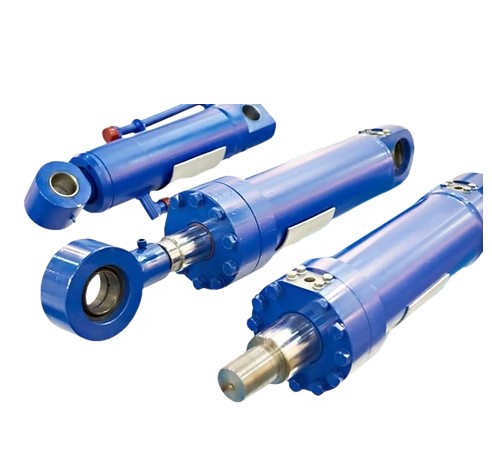
Description
Functions of Hydraulic Cylinders
Hydraulic cylinders can be used to:
- Produce linear mechanical force
- Extend and retract machine components
- Lift and lower loads
- Push and pull mechanical assemblies
- Clamp workpieces
- Tilt equipment
- Position machinery
- Operate lifting mechanisms
- Control mechanical movement
- Hold loads in defined positions where the hydraulic system is designed for it
- Convert hydraulic energy into mechanical movement
The cylinder should be selected according to the required force, stroke, speed, mounting arrangement, pressure, and application conditions.
How a Hydraulic Cylinder Works
Hydraulic fluid is supplied to one side of the cylinder through a hydraulic control valve. The fluid pressure acts on the piston, producing a linear force that moves the piston rod.
For a double-acting cylinder, hydraulic fluid can be supplied to either side of the piston to control extension and retraction.
A simplified arrangement is:
Hydraulic Pump → Control Valve → Hydraulic Cylinder → Return Line → Reservoir
The force generated by a cylinder depends on the hydraulic pressure and the effective piston area. Retraction force can differ from extension force because the piston-rod area occupies part of the piston area.
Types of Hydraulic Cylinders
1. Single-Acting Cylinders
Single-acting cylinders use hydraulic pressure to move the piston in one direction. Return movement can be achieved through a spring, gravity, external load, or another mechanical arrangement depending on the application.
2. Double-Acting Cylinders
Double-acting cylinders use hydraulic pressure on both sides of the piston, allowing controlled extension and retraction.
They are widely used in industrial and mobile hydraulic equipment.
3. Tie-Rod Cylinders
Tie-rod cylinders use threaded tie rods to hold the cylinder assembly together.
They are commonly used in industrial hydraulic applications.
4. Welded Cylinders
Welded cylinders use a welded construction and are commonly used in mobile equipment and applications requiring compact or robust cylinder construction.
5. Telescopic Cylinders
Telescopic cylinders use multiple nested stages to provide a long stroke while maintaining a relatively compact retracted length.
They are commonly used in tipping, lifting, and other applications requiring extended travel.
6. Custom Hydraulic Cylinders
Application-specific cylinders can be manufactured or selected according to required bore diameter, stroke length, mounting arrangement, rod dimensions, pressure rating, and operating environment.
Main Components of a Hydraulic Cylinder
A typical hydraulic cylinder may include:
- Cylinder barrel
- Piston
- Piston rod
- Rod seal
- Piston seal
- Wiper seal
- Guide or wear ring
- End cap
- Gland
- Rod bearing
- O-rings
- Retaining components
- Mounting components
- Ports
- Tie rods or welded construction components
The exact construction varies according to the cylinder design.
Hydraulic Cylinder Spare Parts
Individual cylinder components may be replaced during maintenance or overhaul.
Common spare parts include:
- Piston seals
- Rod seals
- Wiper seals
- Guide rings
- Wear rings
- O-rings
- Piston
- Piston rod
- Cylinder barrel
- Gland
- End caps
- Bushings
- Bearings
- Seal kits
- Mounting components
The correct replacement part should match the cylinder model and dimensions.
Hydraulic Cylinder Force
Cylinder force depends primarily on hydraulic pressure and the effective piston area.
For extension:
Force ≈ Pressure × Piston Area
For retraction:
Force ≈ Pressure × Annular Area
The annular area is the piston area minus the piston-rod area.
Actual cylinder performance can also be affected by friction, seal characteristics, pressure losses, mechanical loading, and operating conditions.
Hydraulic Cylinder Stroke
Stroke length is the distance through which the piston rod can travel.
Cylinder stroke should be selected according to the required mechanical movement.
Important considerations include:
- Required travel
- Retracted length
- Extended length
- Mounting geometry
- Mechanical alignment
- Load movement
- Side loading
- Operating speed
The cylinder should not be operated beyond its specified stroke.
Hydraulic Cylinder Applications
Hydraulic cylinders are used in:
- Hydraulic presses
- Lifting equipment
- Construction machinery
- Excavators
- Cranes
- Forklifts
- Material-handling equipment
- Agricultural machinery
- Mining equipment
- Machine tools
- Injection moulding machinery
- Steel and metal-processing equipment
- Packaging machinery
- Industrial automation
- Hydraulic clamping systems
- Tipping systems
- Industrial lifting systems
- Process machinery
Hydraulic Cylinder Mounting Configurations
Hydraulic cylinders can be supplied with different mounting arrangements, including:
- Clevis mounts
- Flange mounts
- Trunnion mounts
- Foot mounts
- Side mounts
- Eye mounts
- Threaded mounts
- Pin mounts
- Application-specific mounting configurations
The mounting arrangement must match the mechanical structure and movement requirements of the machine.
Common Hydraulic Cylinder Problems
Cylinder problems can affect force, movement, positioning, and hydraulic-system performance.
Common symptoms include:
- External hydraulic leakage
- Internal leakage
- Slow movement
- Uneven movement
- Reduced force
- Cylinder drift
- Damaged piston rod
- Rod seal failure
- Worn piston seals
- Damaged wiper
- Excessive side loading
- Corrosion
- Scratches on the rod
- Bent piston rod
- Excessive vibration
The cylinder and associated hydraulic circuit should be inspected before determining the cause of failure.
Hydraulic Cylinder Leakage
Hydraulic cylinder leakage can occur externally around the piston-rod seal or internally across the piston.
Possible contributing factors include:
- Seal wear
- Damaged piston rod
- Contamination
- Excessive pressure
- Incorrect seal material
- Incorrect installation
- Excessive side loading
- Cylinder misalignment
- Surface damage
Seal replacement may be sufficient in some cases, while damaged rods, barrels, pistons, or other components may require repair or replacement.
Hydraulic Cylinder Inspection and Maintenance
Routine inspection may include:
- Checking for hydraulic oil leakage
- Inspecting piston-rod condition
- Checking rod surface for scratches or corrosion
- Inspecting mounting pins
- Checking bushings and bearings
- Monitoring cylinder movement
- Checking for abnormal drift
- Inspecting seals
- Checking hydraulic connections
- Monitoring system pressure
- Checking cylinder alignment
- Inspecting for excessive side loading
Maintenance should follow the cylinder manufacturer’s recommendations and the requirements of the hydraulic system.
Installation Considerations
Correct installation is important for hydraulic cylinder reliability.
Consider the following:
- Confirm the cylinder bore and stroke.
- Verify operating pressure.
- Check mounting configuration.
- Ensure correct alignment.
- Avoid excessive side loading.
- Confirm hydraulic port connections.
- Use compatible hydraulic fluid.
- Protect the piston rod from impact and contamination.
- Ensure mounting pins and bushings are correctly installed.
- Check hydraulic hoses for sufficient movement.
- Bleed trapped air where required by the system.
- Check for leakage during commissioning.
Incorrect alignment or side loading can significantly increase wear on cylinder seals, guides, rods, and other components.
Hydraulic Cylinder Selection
The correct cylinder should be selected according to the mechanical and hydraulic requirements of the application.
| Specification | Requirement |
|---|---|
| Application | Industrial / Mobile / Construction / Process |
| Cylinder Type | Single-Acting / Double-Acting / Telescopic / Other |
| Bore Diameter | According to Required Force |
| Stroke Length | According to Required Movement |
| Piston Rod Diameter | According to Load and Application |
| Operating Pressure | According to Hydraulic System |
| Maximum Pressure | According to Cylinder Specification |
| Extension Force | According to Application |
| Retraction Force | According to Application |
| Operating Speed | According to System Flow |
| Hydraulic Fluid | Application Specific |
| Port Size | According to Hydraulic Circuit |
| Port Configuration | According to Cylinder |
| Mounting Type | Clevis / Flange / Trunnion / Foot / Other |
| Rod Material | According to Application |
| Cylinder Material | According to Manufacturer |
| Seal Material | According to Fluid and Temperature |
| Operating Temperature | Application Specific |
| Manufacturer / Part Number | As Required |
Replacement Considerations
When replacing a hydraulic cylinder, physical dimensions alone should not determine compatibility.
Verify:
- Original cylinder model and part number
- Bore diameter
- Stroke length
- Piston-rod diameter
- Operating pressure
- Mounting configuration
- Port size
- Port location
- Overall dimensions
- Retracted length
- Extended length
- Hydraulic fluid compatibility
- Seal configuration
- Load requirements
A cylinder with a similar bore and stroke may still be unsuitable if its mounting dimensions, rod size, pressure rating, or port configuration differ.
Hydraulic Cylinder Seal Replacement
Seal kits are commonly used during hydraulic-cylinder maintenance.
A seal kit may contain:
- Rod seal
- Piston seal
- Wiper
- O-rings
- Backup rings
- Guide rings
- Other application-specific sealing components
The correct seal material and dimensions should be confirmed before installation.
When replacing seals, the cylinder rod and barrel should also be inspected for damage that could cause premature seal failure.
Hydraulic Cylinder Failure Investigation
Before replacing or rebuilding a hydraulic cylinder, the complete hydraulic system should be evaluated.
Potential contributing factors include:
- Excessive hydraulic pressure
- Contaminated hydraulic oil
- Incorrect hydraulic fluid
- Misalignment
- Side loading
- Damaged piston rod
- Incorrect seal selection
- Poor installation
- Excessive actuator speed
- Hydraulic shock
- Mechanical overload
- Incorrect mounting
Identifying the underlying cause can help prevent repeated cylinder failures.
Hydraulic Cylinder Supplier – Aegis Projects
Aegis Projects Technology Pvt. Ltd. supplies hydraulic cylinders and hydraulic system components for industrial, commercial, and mobile applications.
Our hydraulic spare-parts range includes hydraulic cylinders, hydraulic cylinder seal kits, piston rods, pistons, hydraulic pumps, hydraulic valves, hydraulic motors, hydraulic hoses, hydraulic fittings, hydraulic filters, hydraulic accumulators, and other hydraulic components.
Hydraulic cylinders can be selected according to the required bore, stroke, piston-rod diameter, operating pressure, force, mounting arrangement, hydraulic fluid, port configuration, seal requirements, and application conditions.
Contact Aegis Projects for hydraulic cylinders, cylinder spare parts, seal kits, and compatible hydraulic components for your machinery and equipment.