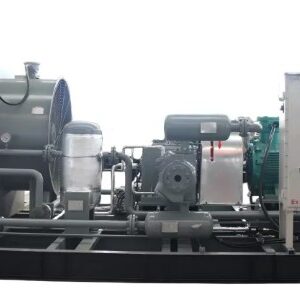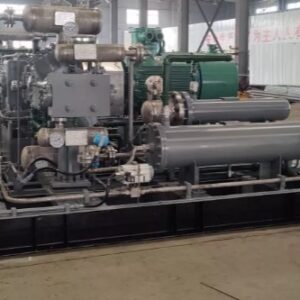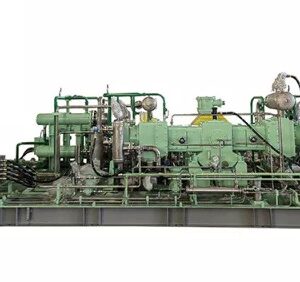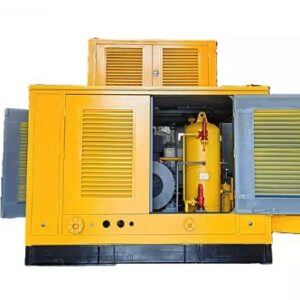
Description
What is a Heat Transfer Skid?
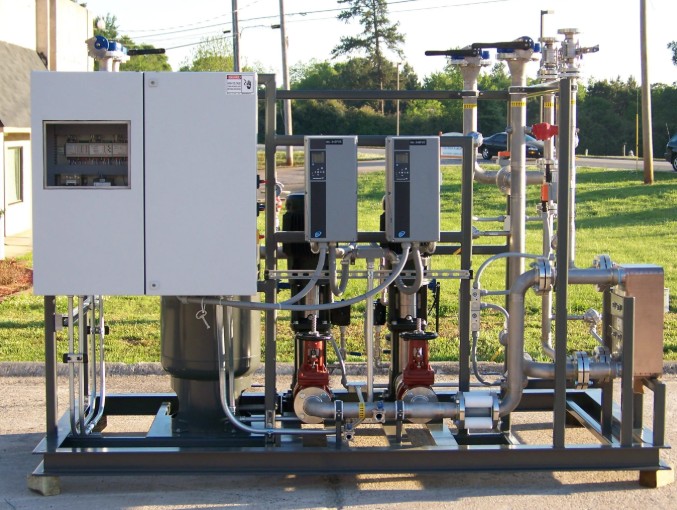
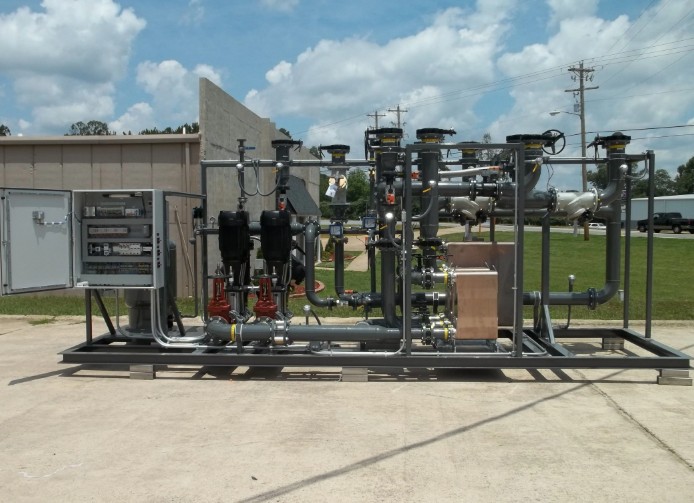
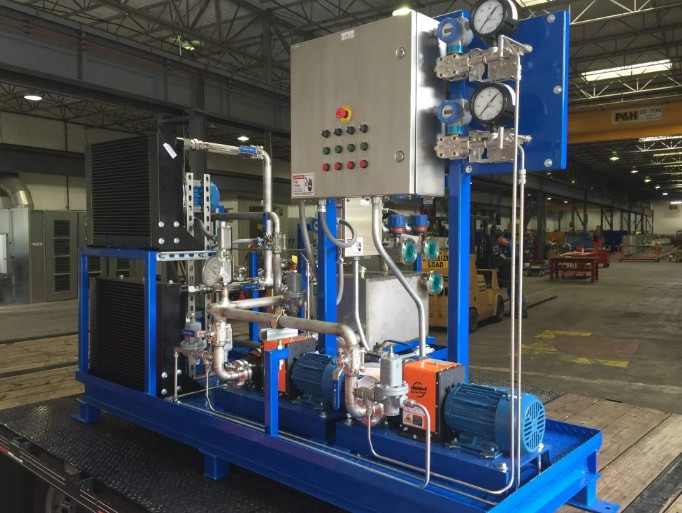
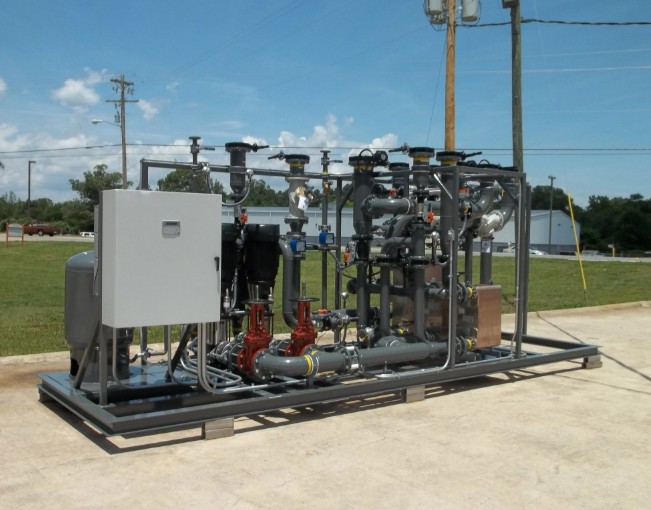
A heat transfer skid is a packaged system designed to transfer thermal energy between two separate fluids without allowing the fluids to mix.
Depending on the application, heat can either be:
- Added to the process fluid for heating
- Removed from the process fluid for cooling
The heat exchanger provides the thermal interface between the two fluid circuits, while pumps, valves and instrumentation regulate the process.
A complete heat transfer skid can include:
- Heat exchanger
- Circulation pumps
- Process piping
- Isolation valves
- Control valves
- Pressure instrumentation
- Temperature sensors
- Flow instrumentation
- PLC
- HMI
- Electrical control panel
- Bypass arrangement
- Safety equipment
- Skid frame
The final configuration is customized according to the process requirements.
Heat Exchanger Types
Aegis Projects heat transfer packages can be configured around different heat exchanger technologies depending on the required heat-transfer duty, fluid characteristics, pressure, temperature and available utilities.
Air-Cooled Heat Exchangers
An air-cooled heat exchanger transfers heat from the process fluid to ambient air.
The process fluid flows through tubes equipped with external fins, while fans move air across the finned tube surfaces. The airflow removes heat from the process fluid without requiring a separate cooling fluid.
Advantages
- Does not require a separate cooling medium
- Relatively simple operating principle
- Suitable for applications where ambient air can provide the required cooling
- Can be integrated into packaged cooling systems
Application Consideration
The cooling capacity of an air-cooled heat exchanger depends significantly on the ambient conditions.
For example, if hot water enters the exchanger at approximately 90°F and the required outlet temperature is 80°F, the ambient air generally needs to be cooler than the desired outlet temperature for effective cooling.
Therefore, ambient temperature and seasonal operating conditions should be considered during system design.
Plate & Frame Heat Exchangers
Plate and frame heat exchangers use a series of plates and gaskets arranged to create separate flow passages for two fluids.
One fluid passes through alternate passages while the second fluid flows through the adjacent passages. Heat is transferred through the plates without direct mixing of the two fluids.
These heat exchangers are commonly used for process cooling applications, particularly where chilled water or water-glycol mixtures are available as the cooling medium.
Example Application
A manufacturing facility may require continuous cooling of process machinery.
The process fluid can circulate through the machinery in a closed loop and return to the heat exchanger. On the opposite side of the heat exchanger, chilled water or a water-glycol mixture circulates to remove heat from the process fluid.
The system can automatically control cooling performance using:
- Circulation pumps
- Temperature sensors
- Flow control valves
- Temperature set points
- PLC controls
- HMI monitoring
The cooling-medium flow can be varied according to the required process temperature.
Advantages
- Efficient heat transfer
- Compact design
- Suitable for closed-loop cooling
- Good temperature control
- Suitable for water and water-glycol applications
Shell & Tube Heat Exchangers
Shell and tube heat exchangers consist of a bundle of tubes installed inside a cylindrical shell.
One process medium flows through the tubes while the second medium flows around the tubes within the shell.
This arrangement is widely used in industrial heating and cooling applications and can be suitable for applications involving higher-pressure fluids or gases, subject to the heat exchanger design and applicable specifications.
Steam Heating Application
A typical application involves heating a process fluid using steam.
In this arrangement:
- Process fluid flows through the tube bundle.
- Steam enters the shell side.
- Heat transfers from the steam to the process fluid.
- The steam loses heat as the process proceeds.
- A portion of the steam may condense.
- Condensate can be collected and returned to the appropriate utility system.
Where condensate is generated, the system may require suitable condensate collection and pumping equipment.
Heat Transfer Skid Features & Options
Depending on the application, Aegis Projects heat transfer skid packages can include:
- Fabricated steel skid structure
- Heat exchanger
- Process circulation pumps
- Pressure transducers
- Temperature sensors
- Temperature control valves
- Electrically actuated control valves
- Pneumatically actuated control valves
- Programmable temperature controller
- PLC automation
- Touch-screen HMI
- Electrical control panel
- Control bypass valve
- Isolation valves
- Process piping
- Instrumentation
- Safety and protection systems
- Custom skid finishing
- 3D engineering models
- System documentation
- Operation and maintenance manuals
- Start-up and commissioning support
The exact equipment configuration depends on the process duty and project requirements.
Automated Temperature Control
Heat transfer skids can be equipped with integrated automation for accurate process temperature management.
A PLC-based control system can monitor process conditions and control the associated pumps and valves according to programmed temperature set points.
Typical control functions may include:
- Process temperature monitoring
- Heating control
- Cooling control
- Pump operation
- Flow control
- Control valve modulation
- High-temperature alarm
- Low-temperature alarm
- Pressure monitoring
- Equipment protection
- Operator interface through HMI
The control system can operate independently or communicate with an existing plant PLC, SCADA or DCS system, depending on the required architecture.
Engineering & Design Standards
Heat transfer skid packages can be engineered with consideration for applicable project standards and specifications.
Depending on the project scope, engineering may include:
Piping Design
Process piping can be designed and fabricated according to applicable piping codes and project requirements.
Structural Design
The skid structure can be engineered according to the required equipment loads, operating conditions and applicable structural standards.
Pressure Equipment
Where pressure vessels or pressure-containing equipment are incorporated, the applicable pressure equipment standards can be considered during engineering.
3D Engineering
Three-dimensional modelling can be used to develop the equipment arrangement, piping layout and skid configuration before fabrication.
Engineering documentation may include:
- 3D models
- Piping layouts
- Equipment arrangement drawings
- Piping drawings
- Electrical drawings
- Instrumentation documentation
- Control system documentation
Final codes and standards are selected according to the project specification, jurisdiction and applicable equipment requirements.
Factory Assembly & Testing
Where required, the heat transfer skid can be assembled and tested before shipment.
Factory testing may include verification of:
- Pump operation
- Valve operation
- Instrumentation
- Temperature control
- Pressure monitoring
- Electrical systems
- PLC programming
- HMI functionality
- Alarm functions
- Control sequences
- System interfaces
Factory acceptance testing can be arranged according to the agreed project requirements.
This approach can help reduce site installation and commissioning requirements.
Applications
Heat transfer skid packages can be designed for a wide range of industrial applications, including:
- Process cooling
- Process heating
- Manufacturing equipment cooling
- Industrial machinery cooling
- Chemical processing
- Pharmaceutical manufacturing
- Food processing
- Oil & gas
- Petrochemical
- Power & energy
- HVAC and hydronic systems
- Industrial utility systems
- Closed-loop cooling systems
- Steam heating systems
- Temperature-controlled process systems
Customized Heat Transfer Solutions
Every industrial process has different thermal requirements. Aegis Projects can develop heat transfer skid packages around the specific operating conditions of the application.
Engineering considerations may include:
- Process fluid
- Heating medium
- Cooling medium
- Required heat-transfer duty
- Process flow rate
- Utility flow rate
- Inlet temperature
- Required outlet temperature
- Operating pressure
- Design pressure
- Fluid compatibility
- Heat exchanger type
- Pump requirements
- Control philosophy
- Automation requirements
- Installation environment
- Available space
Benefits of Skid-Mounted Heat Transfer Systems
Integrated Package
Heat exchangers, pumps, valves, piping, instrumentation and controls can be integrated into a single package.
Controlled Process Temperature
Automated control systems can regulate heating and cooling according to defined temperature requirements.
Fluid Isolation
The heat exchanger keeps the process fluid and heating/cooling medium separated, reducing the possibility of cross-contamination.
Compact Installation
A skid-mounted configuration provides an organized equipment arrangement and can simplify installation.
Automation Ready
PLC and HMI controls can be included or integrated with the plant’s existing automation infrastructure.
Factory Testing
The package can be assembled and tested before delivery according to the project requirements.
Custom Engineering
The system can be designed around the process conditions rather than relying on a fixed standard configuration.
Heat Transfer Skid Packages by Aegis Projects Technology
Aegis Projects Technology Pvt. Ltd. provides engineered heat transfer, pumping, process equipment and automation solutions for industrial applications.
Our Heat Transfer Skid Packages can combine heat exchangers, pumps, piping, valves, instrumentation and automation into a complete process temperature control system.
Whether the requirement involves process heating, process cooling, closed-loop cooling, chilled-water circulation or steam-based heating, the package can be engineered according to the required process conditions.
Request a Customized Heat Transfer Skid
Contact Aegis Projects Technology with your process flow, fluid details, inlet and outlet temperatures, operating pressure and heating/cooling medium requirements to discuss a customized heat transfer skid package.
Final heat exchanger selection, thermal duty, materials, pressure ratings, equipment configuration, control philosophy and applicable standards are subject to application-specific engineering and project specifications.