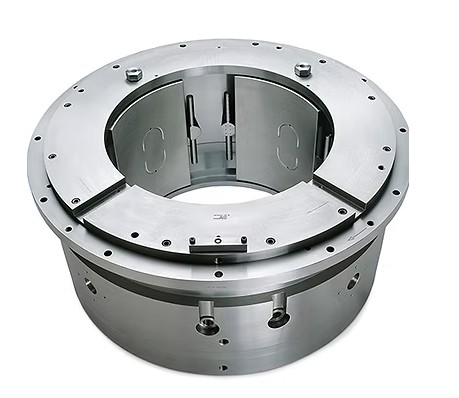
Description
Functions of Centrifugal Compressor Bearings
Bearings within a centrifugal compressor system perform several important functions:
- Support high-speed rotating shafts
- Maintain rotor alignment
- Manage radial loads
- Manage axial or thrust loads
- Reduce friction between moving components
- Support stable rotor rotation
- Help maintain the designed rotor position
- Transfer mechanical loads to the compressor structure
- Support reliable continuous operation
- Help control shaft movement and vibration
The bearing arrangement varies according to the compressor design and may include separate radial and thrust bearing systems.
Types of Bearings Used in Centrifugal Compressors
Radial Bearings
Radial bearings support the compressor shaft against radial loads and help maintain the rotor’s position within the compressor assembly.
They are particularly important for maintaining rotor alignment during high-speed operation.
Thrust Bearings
Thrust bearings manage axial forces generated by the compressor rotor and help control the axial position of the shaft.
Depending on the compressor design, thrust bearings may be designed to accommodate continuous or varying axial loads.
Journal Bearings
Journal bearing arrangements can be used in high-speed centrifugal compressor applications where a lubricating film supports the rotating shaft.
Tilting Pad Bearings
Tilting pad bearing systems can be used in high-speed turbomachinery applications. Individual pads can accommodate changes in shaft position and operating conditions while maintaining an appropriate lubricating film.
Hydrostatic or Hydrodynamic Bearing Systems
Depending on the compressor design, specialized bearing arrangements may use pressurized or self-generated lubricant films to support the rotating shaft.
The actual bearing technology should be matched to the specific compressor design.
Bearing Construction
Centrifugal compressor bearings are precision-engineered components designed for high-speed rotating equipment.
Depending on the bearing type, construction may include:
- Bearing housing
- Bearing shells
- Bearing pads
- Journal surfaces
- Thrust pads
- Babbitt or other bearing lining
- Backing material
- Lubrication passages
- Oil grooves
- Temperature sensing provisions
- Retaining components
The exact construction depends on the compressor manufacturer, bearing design, shaft arrangement, and operating requirements.
Bearing Materials
Bearing materials are selected according to the compressor operating conditions, shaft speed, loading, lubrication system, and required service life.
Potential construction materials may include:
- Steel backing materials
- Babbitt bearing linings
- Specialized bearing alloys
- Engineered bearing materials
- Composite materials
- Specialized coatings where applicable
Material selection should follow the original equipment or approved engineering specification.
Lubrication Requirements
Proper lubrication is essential for many centrifugal compressor bearing arrangements.
The lubrication system may provide:
- Continuous lubricant supply
- Heat removal
- Friction reduction
- Bearing surface protection
- Lubricating film formation
- Contamination control
Depending on the compressor configuration, lubrication may be supplied through an oil circulation system, forced lubrication system, or another manufacturer-specified arrangement.
Important lubrication parameters may include:
- Oil pressure
- Oil temperature
- Oil flow
- Lubricant viscosity
- Oil cleanliness
- Bearing temperature
Bearing Temperature Monitoring
Bearing temperature is an important operating parameter in centrifugal compressor systems.
Temperature monitoring can help identify abnormal operating conditions such as:
- Insufficient lubrication
- Excessive bearing loading
- Bearing wear
- Lubricant degradation
- Misalignment
- Excessive friction
- Cooling problems
Temperature sensors or monitoring devices may be integrated into the compressor control and protection system.
Vibration and Rotor Monitoring
Because centrifugal compressors operate at high rotational speeds, rotor vibration and shaft position can be important indicators of equipment condition.
Depending on the compressor package, monitoring systems may measure:
- Shaft vibration
- Bearing vibration
- Shaft displacement
- Axial position
- Rotor speed
- Bearing temperature
Abnormal readings may indicate issues requiring inspection or corrective maintenance.
Bearing Failure and Wear
Bearing performance can deteriorate due to operating conditions, lubrication problems, contamination, misalignment, excessive loading, or normal service wear.
Potential signs of bearing problems include:
- Increased vibration
- Increased bearing temperature
- Abnormal operating noise
- Shaft movement
- Reduced compressor performance
- Lubricant contamination
- Bearing surface damage
- Metal particles in lubricant
- Unstable rotor operation
- Repeated compressor trips
Early identification of bearing problems can help prevent further damage to the rotor, shaft, seals, and other compressor components.
Common Causes of Bearing Damage
Possible contributing factors include:
- Insufficient lubrication
- Incorrect lubricant viscosity
- Contaminated lubricant
- Excessive bearing load
- Incorrect bearing clearance
- Shaft misalignment
- Rotor imbalance
- Excessive vibration
- Improper installation
- Overheating
- Lubrication system failure
- Long-term operating wear
The actual cause of bearing damage should be established through appropriate inspection and engineering analysis.
Bearing Replacement and Overhaul
Aegis Projects can support bearing requirements for:
- Preventive maintenance
- Compressor overhauls
- Bearing replacement
- Rotor maintenance
- Planned shutdowns
- Compressor refurbishment
- Corrective maintenance
- Equipment modernization
Replacement bearings should be matched to the original compressor design and specified dimensions.
For critical compressor equipment, bearing replacement may require inspection of:
- Shaft journals
- Bearing housing
- Bearing clearances
- Rotor alignment
- Lubrication passages
- Thrust surfaces
- Shaft vibration
- Axial position
Bearing Selection Parameters
| Selection Parameter | Requirement |
|---|---|
| Compressor Type | Centrifugal air compressor configuration |
| Compressor Make | Original equipment manufacturer |
| Compressor Model | Exact compressor model |
| Bearing Type | Radial, thrust, journal, tilting pad, etc. |
| Shaft Speed | Compressor operating speed |
| Bearing Load | Radial and/or axial loading |
| Shaft Diameter | Applicable journal dimensions |
| Bearing Dimensions | Original specified dimensions |
| Lubrication | Oil or manufacturer-specified lubrication system |
| Operating Temperature | Normal and maximum temperature |
| Bearing Clearance | Manufacturer-specified clearance |
| Material | Original or approved bearing material |
| Installation | Compressor-specific bearing arrangement |
Applications
Centrifugal compressor bearings are used in compressor systems serving industries such as:
- Oil & Gas
- Petrochemical
- Chemical Processing
- Power Generation
- Steel
- Cement
- Automotive
- Pharmaceutical
- Food & Beverage
- Textile
- Manufacturing
- Process Industries
- Engineering Industries
- Industrial Utilities
- Large-Scale Compressed-Air Plants
Why Choose Aegis Projects?
Aegis Projects Technology Pvt. Ltd. provides industrial compressor equipment, spare parts, automation solutions, and maintenance-related products for compressed-air and process applications.
Our centrifugal compressor bearing solutions can support:
- Bearing replacement
- Compressor overhauls
- Preventive maintenance
- Rotor and shaft maintenance
- Planned shutdowns
- Compressor refurbishment
- High-speed rotating equipment maintenance
We can assist with bearing selection based on the compressor make, model, bearing type, shaft dimensions, operating speed, load conditions, lubrication arrangement, and original bearing specifications.
Request a Quote
For centrifugal compressor bearings, provide the compressor make and model, bearing identification or part number, shaft dimensions, bearing type, available drawings, and photographs where available.
Aegis Projects can review the equipment requirements and assist with suitable bearing replacement solutions for your centrifugal air compressor system.
Aegis Projects – Industrial Compressor & Spare Parts Solutions