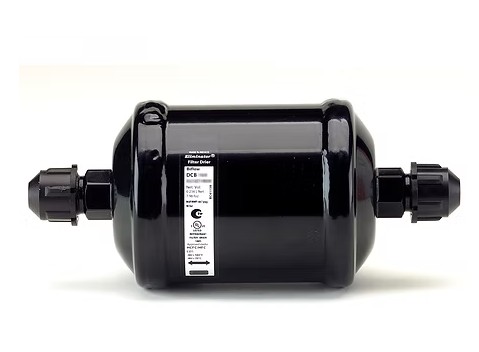
Description
Functions of a Refrigeration Filter Drier
A filter drier performs several important functions:
- Removes moisture from the refrigerant circuit
- Filters solid contaminants and particles
- Helps reduce acids and other contaminants where the drier is designed for this purpose
- Protects expansion valves and other precision components
- Helps protect the compressor and lubrication system
- Reduces the risk of ice formation at restrictions
- Supports clean and reliable refrigerant circulation
- Helps maintain refrigeration-system reliability after servicing or component replacement
The exact filtration and drying capability depends on the desiccant formulation and filter-drier design.
How a Filter Drier Works
Refrigerant passes through the filter drier as it circulates through the refrigeration system.
Inside the drier, a combination of filtering media and desiccant material captures contaminants and absorbs moisture.
A typical flow path can be represented as:
Liquid Refrigerant → Filter Media → Desiccant → Clean, Dry Refrigerant
The filter element captures particles while the desiccant removes moisture from the refrigerant circuit.
The drier should be installed in the appropriate location and flow direction specified by the manufacturer.
Main Components
Depending on the design, a refrigeration filter drier may include:
- Metal housing
- Inlet connection
- Outlet connection
- Filter media
- Desiccant material
- Internal retaining components
- Filter screen
- Flow passages
- Sealing components
Some filter driers are designed as sealed, non-serviceable cartridges, while others may have replaceable elements depending on the application.
Types of Refrigeration Filter Driers
Solid-Core Filter Driers
These use a replaceable or fixed solid desiccant core designed for moisture removal and filtration.
Replaceable-Core Filter Driers
The housing allows the internal filter-drier core to be replaced during maintenance without replacing the complete shell, where applicable.
Bi-Directional Filter Driers
Designed for systems where refrigerant flow may reverse, such as certain heat-pump applications.
Liquid-Line Filter Driers
Installed in the liquid refrigerant line to remove moisture and contaminants before refrigerant reaches the expansion device.
Suction-Line Filter Driers
Often used during system cleanup or after compressor failure to capture contaminants before refrigerant returns to the compressor. Selection should be based on the specific application and pressure-drop requirements.
Desiccant Materials
Filter driers may use different desiccant materials depending on the refrigerant, oil, moisture-control requirement, and application.
Common desiccant technologies include:
- Molecular sieve
- Activated alumina
- Other application-specific desiccant blends
The correct desiccant should be selected according to the refrigeration-system requirements and compatible refrigerants and oils.
Applications
Refrigeration filter driers are commonly used in:
- Commercial refrigeration systems
- Industrial refrigeration systems
- Cold rooms
- Cold storage plants
- Freezers
- Refrigerated display cabinets
- Food processing refrigeration
- Beverage cooling equipment
- Chillers
- Air-conditioning systems
- HVAC-R systems
- Process cooling systems
- Heat pump systems
- Refrigeration condensing units
Importance of Moisture Removal
Moisture inside a refrigeration circuit can create several operational problems.
Depending on system conditions, excessive moisture can:
- Freeze at expansion devices or restrictions
- Affect refrigerant flow
- Contribute to corrosion
- React with refrigerant/oil under unsuitable conditions
- Contribute to acid formation in certain system conditions
- Affect compressor lubrication and component reliability
A correctly selected filter drier helps control moisture and contaminants as part of a properly maintained refrigeration system.
Common Filter Drier Problems
Excessive Pressure Drop
A saturated or heavily contaminated filter drier can develop increased pressure drop across the component.
Possible causes include:
- Contamination
- Excessive particle loading
- Moisture saturation
- Incorrect sizing
- Restricted flow
Moisture Saturation
A drier has a finite moisture-absorption capacity. Once its drying capacity is exhausted, it may no longer provide the intended moisture-control performance.
Contamination
After compressor burnout or major refrigeration-system failure, the circuit may contain contaminants that require appropriate system cleanup and a suitable filter-drier arrangement.
Incorrect Installation
Installing the wrong filter drier, incorrect flow direction, or unsuitable connection can affect refrigeration-system performance.
Leakage
Leakage can occur at connections or damaged components and should be addressed immediately because refrigerant-system leakage can also allow moisture and contaminants to enter the circuit.
Filter Drier Replacement
Filter driers are commonly replaced during refrigeration-system maintenance, especially after:
- Compressor replacement
- Refrigeration-system opening
- Major component replacement
- Refrigerant-system contamination
- Moisture-related problems
- Compressor burnout cleanup
- Significant refrigerant-circuit repairs
The replacement interval depends on system condition and manufacturer/service recommendations.
Installation Considerations
Correct installation is important for filter-drier performance.
Important considerations include:
- Select a filter drier compatible with the refrigerant
- Confirm compatibility with the refrigeration oil
- Match the required flow capacity
- Check the pressure and temperature rating
- Install according to the marked flow direction where applicable
- Use the correct pipe connection size
- Minimize contamination during installation
- Protect the drier from excessive brazing heat
- Follow the manufacturer’s installation procedure
- Check the completed system for leakage
The refrigeration circuit should be properly evacuated and dehydrated after servicing according to the applicable service procedure.
Inspection & Maintenance
Filter driers are generally not repaired internally. When their capacity is exhausted or contamination is suspected, replacement is normally considered according to the system requirements.
Checks may include:
- Inspect the filter-drier housing
- Check for refrigerant leakage
- Check pressure drop where measurement points are available
- Inspect the refrigeration system for contamination
- Check the condition of associated sight-glass/moisture indicators
- Replace the filter drier after major system service when required
- Verify correct flow direction
- Confirm refrigerant and oil compatibility
Filter Drier Selection Parameters
| Parameter | Requirement |
|---|---|
| Application | Refrigeration / HVAC-R |
| Filter Drier Type | Liquid-line / suction-line / replaceable-core / bi-directional |
| Refrigerant | System-specific |
| Refrigeration Capacity | According to system |
| Flow Rate | Application-specific |
| Connection Size | According to piping |
| Connection Type | Solder / flare / threaded / other |
| Pressure Rating | According to system |
| Temperature Range | Application-specific |
| Desiccant Type | Application-specific |
| Filtration Requirement | According to system condition |
| Moisture Removal Capacity | As required |
| Flow Direction | As specified |
| Body Material | As specified |
| Oil Compatibility | Required |
| Manufacturer | As specified |
| Part Number | Required for exact replacement |
Replacement Considerations
A replacement filter drier should be selected according to the refrigeration-system requirements rather than only by physical dimensions.
Important information includes:
- Original filter-drier part number
- Refrigeration equipment model
- Refrigerant type
- Refrigeration capacity
- Liquid or suction-line application
- Connection size
- Flow direction
- Pressure and temperature requirements
- Desiccant requirement
- Filtration capacity
- Refrigeration oil compatibility
Using an incorrectly sized or incompatible filter drier can result in excessive pressure drop or inadequate moisture and contaminant removal.
Why Choose Aegis Projects?
Aegis Projects Technology supplies refrigeration filter driers and filtration components for commercial, industrial, cold-storage, and HVAC-R applications.
We can assist with replacement selection based on:
- Original part number
- Refrigeration equipment model
- Refrigerant
- System capacity
- Connection size
- Installation location
- Pressure and temperature requirements
- Moisture-removal requirements
- Filtration requirements
Contact Aegis Projects Technology for refrigeration filter driers and other refrigeration spare parts.