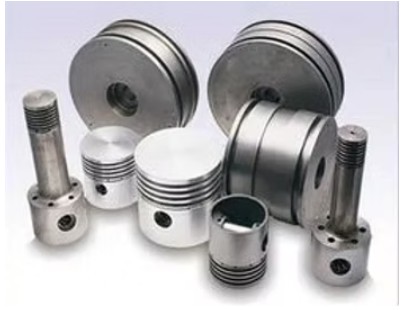
Description
What Is a Reciprocating Compressor Piston?
A compressor piston is a precision-engineered component that moves within the compressor cylinder during each compression cycle.
During operation:
Suction → Compression → Discharge → Expansion/Return
The piston works together with components such as:
- Cylinder
- Piston rings
- Rider rings
- Piston rod
- Cylinder valves
- Cylinder head
- Packing system
- Crosshead
- Connecting rod
- Crankshaft
The piston must maintain the required sealing and running clearances while withstanding repeated mechanical loads, pressure forces, temperature variations, and continuous reciprocating motion.
Key Functions of the Piston
1. Gas Compression
The piston reduces the volume of gas inside the cylinder, increasing its pressure before discharge.
2. Pressure Containment
The piston operates against the pressure generated inside the cylinder and must be suitable for the compressor’s operating conditions.
3. Support for Sealing Components
Depending on the compressor design, piston rings and rider/support rings are installed around the piston to control gas leakage and maintain appropriate running clearances.
4. Efficient Reciprocating Motion
The piston is designed to operate continuously with the piston rod, crosshead, connecting rod, and crank mechanism.
5. Heat Management
During compression, the piston can be exposed to elevated temperatures. Its design and material must therefore be suitable for the specified gas, compression ratio, cooling arrangement, and operating temperature.
Available Piston Configurations
Aegis Projects can support piston requirements for different reciprocating compressor configurations, including:
- Single-acting pistons
- Double-acting compressor pistons
- Single-stage compressor pistons
- Multi-stage compressor pistons
- High-pressure compressor pistons
- Process gas compressor pistons
- Natural gas compressor pistons
- CNG compressor pistons
- Hydrogen compressor pistons
- Industrial air compressor pistons
- Oil-free reciprocating compressor pistons
- Lubricated reciprocating compressor pistons
- Horizontal compressor pistons
- Vertical compressor pistons
- Opposed compressor pistons
- V-type and W-type compressor configurations
Final piston configuration depends on the compressor design and original engineering specification.
Piston Materials
The piston material is selected according to the application and operating conditions.
Important selection factors include:
- Working pressure
- Gas composition
- Operating temperature
- Cylinder dimensions
- Compressor speed
- Lubrication arrangement
- Cooling arrangement
- Required wear resistance
- Chemical compatibility
- Piston ring and rider ring arrangement
Depending on the compressor design, pistons may be manufactured from suitable metallic or engineered materials specified by the original compressor design.
Material selection should always be confirmed against the compressor manufacturer’s specification and actual operating conditions.
Precision Manufacturing
Replacement pistons require accurate dimensional control because even small deviations in piston geometry or running clearance can affect compressor performance.
Important manufacturing characteristics may include:
- Accurate piston diameter
- Controlled dimensional tolerances
- Correct piston length
- Proper ring-groove dimensions
- Accurate piston rod connection
- Appropriate surface finish
- Correct weight and balance
- Proper alignment
- Suitable material properties
Aegis Projects can support replacement requirements based on original drawings, component dimensions, photographs, samples, or compressor identification details where available.
Piston Rings and Rider Rings
Pistons commonly operate together with specialized rings.
Piston Rings
Piston rings help reduce gas leakage between the piston and cylinder wall while allowing the piston to reciprocate.
Rider Rings
Rider rings can provide support and maintain the required clearance between the piston and cylinder surface, depending on the compressor design.
Ring material and configuration depend on:
- Gas being compressed
- Pressure
- Temperature
- Lubrication
- Cylinder material
- Compressor speed
- Required service life
Aegis Projects can also support associated piston rings, rider rings, ring sets, and related reciprocating compressor spare parts.
Applications
Replacement reciprocating compressor pistons are used across a wide range of industrial applications, including:
Natural Gas Compression
For natural gas gathering, transportation, boosting, storage, processing, and distribution systems.
CNG Systems
For CNG compression, refueling stations, cascade filling, gas transfer, and high-pressure compression systems.
Hydrogen Compression
For applications requiring compression of hydrogen gas, subject to suitable materials, sealing arrangements, and application-specific engineering.
Industrial Air Compression
For reciprocating air compressors used in manufacturing and industrial facilities.
Process Gas Compression
For chemical, petrochemical, refinery, and process industries.
Oil & Gas
For gas gathering, gas boosting, fuel gas, process gas, and other upstream, midstream, and downstream applications.
Chemical & Petrochemical Industries
For compression of gases used in chemical processing and petrochemical operations.
Piston Replacement & Compressor Overhaul
Piston replacement is often performed as part of a broader reciprocating compressor overhaul.
During an overhaul, the piston may be inspected for:
- Surface wear
- Scoring
- Cracks
- Deformation
- Excessive clearance
- Ring groove wear
- Connection damage
- Abnormal contact marks
- Thermal damage
- Corrosion
Depending on the condition, replacement of associated components such as piston rings, rider rings, piston rods, packing components, gaskets, and cylinder components may also be required.
Piston Selection Information
To identify the correct replacement piston, the following information is recommended:
| Parameter | Required Information |
|---|---|
| Compressor Make | Manufacturer / Brand |
| Compressor Model | Exact model number |
| Serial Number | Compressor serial number |
| Part Number | Existing piston part number |
| Cylinder Number | Applicable cylinder/stage |
| Piston Diameter | Existing piston diameter |
| Piston Length | Overall length |
| Stroke | Compressor stroke |
| Gas | Gas being compressed |
| Suction Pressure | Operating suction pressure |
| Discharge Pressure | Operating discharge pressure |
| Operating Temperature | Relevant operating temperature |
| Compressor Speed | RPM |
| Piston Ring Arrangement | Ring type and quantity |
| Rider Ring Arrangement | Where applicable |
| Lubrication | Oil-free or lubricated |
| Cooling | Air-cooled or water-cooled |
| Drawing | Original drawing, if available |
Providing the compressor model, serial number, existing part number, photographs, and dimensional details can help ensure accurate identification of the required replacement component.
Why Piston Quality Matters
A piston operating with incorrect dimensions or unsuitable materials can contribute to:
- Increased gas leakage
- Higher compression temperatures
- Reduced compressor efficiency
- Increased ring wear
- Cylinder surface damage
- Abnormal vibration
- Increased maintenance requirements
- Reduced component service life
For this reason, piston replacement should be based on the compressor’s original engineering requirements and actual operating conditions.
Related Reciprocating Compressor Spare Parts
Aegis Projects can also support a range of associated reciprocating compressor components, including:
- Compressor Cylinders
- Piston Rings
- Rider Rings
- Piston Rods
- Connecting Rods
- Crossheads
- Crankshafts
- Cylinder Valves
- Valve Plates
- Valve Springs
- Packing Rings
- Oil Scraper Rings
- Bearings
- Gaskets
- Seals
- Intercoolers
- Aftercoolers
- Pulsation Dampeners
- Lubrication Components
Industries Served
Piston and reciprocating compressor spare parts are applicable across:
- Oil & Gas
- CNG
- Natural Gas
- Hydrogen
- Chemical Processing
- Petrochemical
- Refineries
- Power Generation
- Industrial Manufacturing
- Gas Processing
- Gas Storage
- Industrial Utilities
- Process Industries
Aegis Projects – Reciprocating Compressor Spare Parts
Aegis Projects Technology Pvt. Ltd. provides industrial compressor spare parts and engineered replacement components for reciprocating and other compressor systems.
Our piston supply and replacement support can be based on OEM references, compressor model information, existing component dimensions, technical drawings, samples, and application requirements.
Whether you require a replacement piston for an existing compressor overhaul or components for a planned maintenance program, the correct specification should be established according to the compressor design and operating conditions.
Contact Aegis Projects Technology for piston replacement requirements, compressor spare parts, technical assistance, and application-specific component selection.