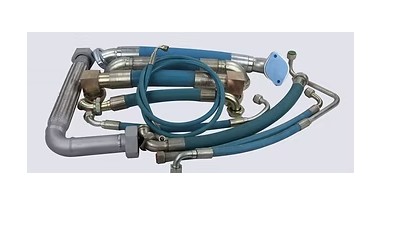
Description
Function of Oil Hoses
Oil hoses provide controlled and flexible oil flow between components of the compressor lubrication system.
Their functions may include:
- Transporting lubricating oil between system components
- Connecting fixed and vibrating equipment components
- Accommodating thermal expansion
- Reducing transmission of vibration through rigid piping
- Connecting pumps, coolers, filters, and lubrication points
- Providing flexible connections during maintenance or equipment installation
- Supporting reliable oil circulation within auxiliary systems
The exact routing and function depend on the compressor’s lubrication-system design.
Applications of Oil Hoses
Depending on the compressor configuration, oil hoses may be installed between:
- Main oil pump and lubrication circuit
- Auxiliary oil pump and lubrication circuit
- Oil cooler and lubrication circuit
- Oil filter and compressor components
- Oil reservoir and pump
- Bearings and lubrication headers
- Gearbox and lubrication system
- Pressure-regulating components
- Instrumentation or auxiliary oil circuits
The hose should always be installed according to the original compressor piping arrangement and manufacturer’s specifications.
Construction of Oil Hoses
Oil hoses used in compressor systems are generally designed as flexible, pressure-rated assemblies suitable for the specified lubricant and operating environment.
A typical hose assembly may consist of:
- Inner oil-resistant tube
- Reinforcement layer
- Outer protective cover
- End fittings
- Crimped or assembled ferrules
- Sealing elements
- Protective sleeves where required
The construction can vary according to pressure, temperature, oil compatibility, vibration, installation conditions, and hose design.
Hose Materials
Oil hose materials must be compatible with the lubricant and operating temperature.
Depending on the application, hose construction may use:
- Oil-resistant synthetic rubber
- Nitrile-based elastomers
- Fluoroelastomer materials
- PTFE
- Thermoplastic materials
- Stainless-steel braided reinforcement
- Textile reinforcement
- Wire reinforcement
Material selection should be based on the actual oil type, temperature, pressure, and manufacturer requirements rather than material name alone.
Reinforcement and Pressure Rating
The reinforcement structure determines the hose’s ability to withstand internal pressure and mechanical loads.
Depending on the application, hoses may use:
- Textile braid
- Wire braid
- Multiple reinforcement layers
- Stainless-steel braid
- Other application-specific reinforcement
The hose pressure rating must be suitable for both normal operating pressure and the system’s applicable pressure conditions.
A hose should never be selected solely by its outside diameter or thread size.
Oil Hose End Connections
Oil hoses can be supplied with different end configurations depending on the compressor’s piping arrangement.
Possible connection types include:
- Male threaded ends
- Female threaded ends
- Flange connections
- Banjo fittings
- Elbow fittings
- Straight fittings
- Swivel connections
- Custom compressor-specific fittings
The correct fitting must match the original connection type, thread standard, sealing method, and orientation.
Importance of Correct Oil Hose Selection
An oil hose is a relatively small component but plays an important role in maintaining lubrication-system integrity.
An incorrectly selected hose may result in:
- Oil leakage
- Reduced oil flow
- Hose swelling or deterioration
- Premature hose failure
- Excessive pressure drop
- Fitting leakage
- Vibration-related damage
- Lubricant contamination
- Unexpected compressor shutdown
The hose must therefore be compatible with the compressor’s lubricant and operating conditions.
Common Oil Hose Problems
Oil hoses can deteriorate due to age, heat, pressure, vibration, contamination, or improper installation.
Common problems include:
- Cracking
- Hardening
- Softening or swelling
- Abrasion
- External damage
- Internal deterioration
- Oil leakage
- Fitting leakage
- Reinforcement damage
- Kinking
- Excessive bending
- Torsional stress
- Hose blistering
- Corrosion of metallic fittings
Regular inspection is particularly important around high-temperature areas and locations exposed to continuous vibration.
Oil Hose Failure Causes
Excessive Temperature
Continuous exposure to temperatures beyond the hose’s rating can accelerate material degradation.
Incorrect Oil Compatibility
Some hose materials may deteriorate when exposed to unsuitable lubricants or additives.
Excessive Pressure
Operating above the hose’s rated pressure can damage the reinforcement or hose structure.
Improper Routing
Sharp bends, twisting, compression, or contact with moving components can cause premature failure.
Vibration
Continuous compressor vibration can cause fatigue at the hose body or fittings if the assembly is not properly supported.
Abrasion
Contact with brackets, machinery, piping, or other surfaces can wear through the protective outer layer.
Oil Hose Installation
Correct installation is essential for hose reliability.
During installation:
- Avoid twisting the hose
- Maintain the manufacturer’s minimum bend radius
- Avoid sharp bends near fittings
- Prevent contact with hot surfaces where possible
- Keep the hose away from moving machinery
- Provide adequate clearance
- Use correct clamps and supports where required
- Ensure fittings are correctly aligned
- Do not force a hose into an incorrect orientation
- Check for leakage after installation
A hose should not be used as a substitute for incorrectly positioned rigid piping.
Maintenance and Inspection
Oil hoses should be inspected periodically as part of the compressor lubrication-system maintenance program.
Inspection may include:
- Checking for visible oil leakage
- Inspecting the hose cover
- Checking for cracks or hardening
- Checking for swelling or deformation
- Inspecting fittings
- Checking for abrasion
- Checking hose routing
- Checking for excessive vibration
- Inspecting support clamps
- Checking for contact with hot or moving components
- Verifying connection tightness
- Replacing hoses showing signs of deterioration
Replacement intervals should follow the compressor manufacturer’s recommendations and the actual operating environment.
Replacement of Oil Hoses
When replacing an oil hose, the new assembly should match the requirements of the original installation.
Important parameters include:
- Compressor make
- Compressor model
- Compressor serial number
- Existing hose part number
- Hose internal diameter
- Hose overall length
- Operating pressure
- Operating temperature
- Oil type
- Hose material
- Reinforcement type
- End fitting type
- Thread size
- Flange size where applicable
- Fitting orientation
- Minimum bend radius
- Installation arrangement
Where available, providing photographs of the existing hose and its fittings along with dimensions can help identify the correct replacement.
Oil Hose Selection Specifications
| Parameter | Requirement |
|---|---|
| Component | Oil Hose |
| Equipment | Centrifugal Air Compressor |
| Compressor Make | As per equipment |
| Compressor Model | As per equipment |
| Hose Application | Lubrication / Auxiliary Oil Circuit |
| Oil Type | As specified |
| Internal Diameter | As per original system |
| Overall Length | As required |
| Operating Pressure | As per system |
| Operating Temperature | As per application |
| Hose Material | Oil-compatible material |
| Reinforcement | Textile / Wire / Stainless Steel / As applicable |
| End Connections | Threaded / Flanged / Custom |
| Fitting Size | As per existing connection |
| Fitting Orientation | As required |
| Bend Radius | As specified by hose manufacturer |
| Installation | Compressor lubrication system |
| Application | Oil transfer and flexible connection |
Why Choose Aegis Projects?
Aegis Projects Technology provides industrial compressor spare parts and replacement components for centrifugal air compressor lubrication systems.
Our oil hose solutions can be evaluated according to the compressor’s original hose configuration, oil type, pressure and temperature requirements, dimensions, and connection arrangement.
We support requirements for:
- Compressor oil hoses
- Hydraulic and lubrication hoses where applicable
- Custom-length hose assemblies
- Oil-resistant flexible hoses
- Braided hose assemblies
- Hose end fittings
- Replacement lubrication-system hoses
- Compressor maintenance spares
- Replacement and retrofit requirements
For accurate identification, share the compressor make, model, existing hose photographs, hose length, internal diameter, fitting details, thread size, pressure, temperature, and oil specification wherever available.
Request a Quote
Looking for oil hoses for a centrifugal air compressor?
Contact Aegis Projects Technology Pvt. Ltd. with your compressor and hose details. Our team can assist with identifying a suitable replacement hose assembly for your compressor lubrication system.