Description
Functions of Hydraulic Filters
Hydraulic filters are used to:
- Remove particulate contamination from hydraulic oil
- Protect hydraulic pumps
- Protect hydraulic valves
- Protect hydraulic motors
- Protect hydraulic cylinders
- Reduce contamination-related component wear
- Maintain hydraulic fluid cleanliness
- Support reliable hydraulic system operation
- Remove particles generated by component wear
- Filter hydraulic oil during circulation
- Support preventive maintenance programs
The required filtration level depends on the hydraulic equipment, component sensitivity, operating conditions, and manufacturer’s cleanliness requirements.
How Hydraulic Filtration Works
Hydraulic fluid passes through a filter element containing a filtration medium designed to retain particles while allowing hydraulic oil to flow through.
A simplified filtration arrangement is:
Hydraulic Reservoir → Pump → Hydraulic Filter → Control Valve → Actuator → Return Filter → Reservoir
The exact filter location varies according to the hydraulic system design.
Filters may be installed on the suction, pressure, return, or offline filtration circuit.
Types of Hydraulic Filters
1. Suction Filters and Strainers
Suction filters or strainers are installed on the pump suction side to help prevent larger contaminants from entering the hydraulic pump.
They are selected according to the pump’s suction requirements and system design.
2. Pressure-Line Filters
Pressure-line filters are installed in pressurized sections of the hydraulic circuit.
They can protect sensitive downstream components from particulate contamination.
3. Return-Line Filters
Return-line filters remove contaminants from hydraulic fluid before it returns to the reservoir.
They are commonly used as part of the hydraulic system’s general contamination-control strategy.
4. Offline Filtration Filters
Offline or kidney-loop filtration systems use a separate pump and filter circuit to continuously clean hydraulic fluid independently of the main hydraulic circuit.
5. Breather Filters
Breather filters help prevent airborne particles and contaminants from entering the hydraulic reservoir as the fluid level changes.
6. High-Pressure Filters
High-pressure filters are designed for installation in hydraulic circuits operating at higher pressures, subject to their specified pressure rating.
Hydraulic Filter Elements
The filter element is the replaceable filtration component installed inside a filter housing.
Filter elements can be available with different:
- Filtration ratings
- Filter media
- Flow capacities
- Pressure ratings
- Dimensions
- Sealing configurations
- Contamination-holding capacities
- Connection arrangements
Filter-element selection should always be based on the filter housing and hydraulic system requirements.
Hydraulic Filter Accessories
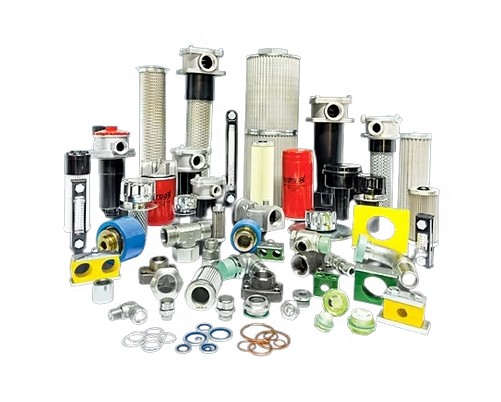
Hydraulic filtration systems may require several supporting components and accessories.
These can include:
- Filter housings
- Filter elements
- Suction strainers
- Filter bowls
- Filter heads
- Bypass valves
- Differential-pressure indicators
- Clogging indicators
- Pressure gauges
- Breather filters
- Magnetic separators
- Drain valves
- Isolation valves
- Mounting brackets
- Seals
- O-rings
- Filter adapters
- Connection fittings
The actual accessories required depend on the filter design and hydraulic installation.
Hydraulic Filter Housings
The filter housing holds the filter element and provides the required inlet and outlet flow paths.
A filter housing may include:
- Filter head
- Filter bowl
- Element support
- Bypass arrangement
- Differential-pressure indicator
- Sealing components
- Inlet connection
- Outlet connection
- Mounting arrangement
The housing must be suitable for the system’s operating pressure, flow, temperature, and hydraulic fluid.
Filter Clogging Indicators
A clogging or differential-pressure indicator can provide an indication of increasing pressure drop across the filter element.
As the filter becomes loaded with contaminants, the pressure difference across the filter may increase.
Depending on the design, an indicator may provide:
- Visual indication
- Electrical switching signal
- Differential-pressure indication
- Alarm signal
This can help maintenance personnel identify when filter-element inspection or replacement may be required.
Hydraulic Filter Bypass Valves
Some filter assemblies incorporate bypass arrangements.
A bypass valve can allow hydraulic fluid to pass around the filter element when the differential pressure reaches a specified condition, depending on the filter design.
The bypass setting must be appropriate for the filter and hydraulic application.
Hydraulic Breather Filters
Reservoir breathers help control contamination entering the hydraulic tank through the air exchange that occurs as the hydraulic-fluid level changes.
Breather systems may help prevent:
- Dust
- Dirt
- Airborne particles
- Moisture
- Other environmental contaminants
The appropriate breather should be selected according to reservoir size, breathing requirements, environmental conditions, and system design.
Filter Media
Hydraulic filter elements can use different filtration media depending on the application.
Possible media include:
- Cellulose
- Synthetic media
- Wire mesh
- Stainless-steel mesh
- Other application-specific materials
Synthetic filtration media may provide different filtration characteristics from conventional media. The appropriate media should be selected according to the hydraulic system and manufacturer’s specifications.
Filtration Rating
Filter elements can be specified according to their filtration rating.
Selection may involve parameters such as:
- Nominal filtration rating
- Absolute filtration rating
- Micron rating
- Beta ratio
- Dirt-holding capacity
The correct rating should be selected according to the cleanliness requirements of the hydraulic components being protected.
A smaller micron rating is not automatically suitable for every application because filtration level also affects pressure drop, flow capacity, and filter service life.
Hydraulic Filter Applications
Hydraulic filters and accessories are used in:
- Industrial hydraulic systems
- Hydraulic power units
- Manufacturing machinery
- Hydraulic presses
- Machine tools
- Injection moulding machines
- Construction equipment
- Material-handling equipment
- Mining machinery
- Agricultural machinery
- Mobile hydraulic equipment
- Packaging machinery
- Steel and metal-processing equipment
- Process machinery
- Hydraulic test systems
- Automation equipment
Importance of Hydraulic Fluid Cleanliness
Contaminated hydraulic oil can contribute to wear and malfunction of precision hydraulic components.
Contamination can affect:
- Hydraulic pumps
- Hydraulic valves
- Proportional valves
- Servo valves
- Hydraulic motors
- Hydraulic cylinders
- Bearings
- Seals
Maintaining the appropriate fluid cleanliness level can help reduce contamination-related wear and support reliable hydraulic system operation.
The required cleanliness level should be established according to the hydraulic equipment manufacturer’s specifications and system requirements.
Common Hydraulic Filter Problems
Common filtration-related problems include:
- Filter element blockage
- Excessive pressure drop
- Incorrect filter element
- Filter bypass operation
- Filter housing leakage
- Damaged seals
- Incorrect filter installation
- Breather blockage
- Insufficient filtration
- Filter element collapse or damage
- Incorrect filtration rating
- Contaminated hydraulic oil despite filtration
A filter should be investigated if the system experiences abnormal pressure drop, reduced flow, or repeated contamination problems.
Hydraulic Filter Inspection and Maintenance
Routine filter maintenance may include:
- Checking differential pressure
- Inspecting filter indicators
- Checking filter housing condition
- Inspecting seals and O-rings
- Checking for external leakage
- Replacing filter elements when required
- Inspecting suction strainers
- Checking breather filters
- Monitoring hydraulic fluid cleanliness
- Checking filter bypass operation
- Inspecting mounting arrangements
- Checking inlet and outlet connections
Filter replacement intervals should be determined according to operating conditions, filter indicators, contamination levels, manufacturer recommendations, and maintenance procedures.
Filter Element Replacement
Before replacing a filter element:
- Confirm the correct filter model.
- Verify the filter-element part number.
- Confirm filtration rating.
- Check flow capacity.
- Confirm hydraulic fluid compatibility.
- Inspect the filter housing.
- Replace damaged seals where required.
- Install the element correctly.
- Ensure the filter housing is properly secured.
- Check for leakage after restarting the system.
Using an incorrect filter element can cause excessive pressure drop, inadequate filtration, bypass operation, or damage to the filter assembly.
Hydraulic Filter Selection
The correct filter should be selected according to the hydraulic system and the component being protected.
| Specification | Requirement |
|---|---|
| Application | Industrial / Mobile / Hydraulic Power Unit |
| Filter Type | Suction / Pressure / Return / Offline / Breather |
| Filtration Rating | According to System Requirement |
| Filter Media | Cellulose / Synthetic / Mesh / Other |
| Flow Rate | According to Hydraulic Circuit |
| Operating Pressure | According to Filter Rating |
| Maximum Pressure | According to Manufacturer |
| Hydraulic Fluid | Application Specific |
| Fluid Viscosity | According to System |
| Operating Temperature | Application Specific |
| Filter Housing | According to Element |
| Element Size | According to Housing |
| Contamination-Holding Capacity | Application Specific |
| Bypass Valve | Required / Optional |
| Bypass Setting | According to Filter Specification |
| Clogging Indicator | Visual / Electrical / Differential Pressure |
| Connection Size | According to System |
| Mounting | Inline / Tank Mounted / Manifold / Other |
| Breather | As Required |
| Manufacturer / Part Number | As Required |
Replacement Considerations
When replacing hydraulic filters or filter elements, the replacement should be matched to the original application.
Verify:
- Filter model
- Filter-element part number
- Filtration rating
- Filter media
- Flow capacity
- Pressure rating
- Hydraulic-fluid compatibility
- Filter dimensions
- Sealing arrangement
- Connection size
- Bypass setting
- Indicator configuration
- Housing compatibility
A filter element that physically fits the housing may still be unsuitable if its filtration characteristics, flow capacity, pressure rating, or bypass configuration differ.
Hydraulic Filters and Accessories Supplier – Aegis Projects
Aegis Projects Technology Pvt. Ltd. supplies hydraulic filtration components and accessories for industrial and commercial hydraulic systems.
Our hydraulic range includes hydraulic filters, filter elements, suction strainers, pressure-line filters, return-line filters, offline filtration components, filter housings, clogging indicators, breathers, hydraulic pumps, hydraulic valves, hydraulic hoses, hydraulic cylinders, and other hydraulic spare parts.
Hydraulic filters and accessories can be selected according to the required filtration rating, flow rate, operating pressure, hydraulic fluid, filter media, filter housing, bypass requirements, contamination level, connection configuration, and application conditions.
Contact Aegis Projects for hydraulic filters, filter elements, and compatible filtration accessories for your hydraulic machinery and equipment.