Description
Functions of a Hydraulic Filtration Trolley
A hydraulic filtration trolley can be used for:
- Removing particulate contamination from hydraulic oil
- Offline filtration of hydraulic fluid
- Cleaning hydraulic reservoirs
- Transferring filtered oil between containers
- Supporting hydraulic-system commissioning
- Removing contamination after hydraulic maintenance
- Maintaining hydraulic fluid cleanliness
- Supporting preventive maintenance programs
- Filtering hydraulic oil before filling equipment
- Cleaning stored or recovered hydraulic oil
- Supporting contamination-control procedures
The filtration process and achievable cleanliness level depend on the pump, filter element, filter rating, fluid properties, flow rate, and condition of the hydraulic oil.
How a Hydraulic Filtration Trolley Works
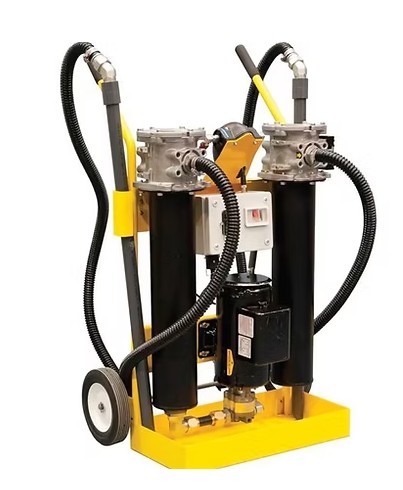
A typical filtration trolley uses a pump to draw hydraulic fluid from a reservoir or oil container. The fluid is passed through one or more filter elements before being returned to the reservoir or transferred to another container.
A simplified arrangement is:
Oil Reservoir → Suction Line → Pump → Filter → Clean Oil Outlet → Reservoir
The filtration trolley operates independently of the machine’s primary hydraulic circuit, making it suitable for offline or kidney-loop filtration.
Depending on the trolley configuration, additional components such as suction strainers, pressure gauges, differential-pressure indicators, hoses, valves, and electrical controls may be included.
Main Components
A hydraulic filtration trolley may consist of:
- Electric motor
- Hydraulic oil pump
- Filter housing
- Filter element
- Suction hose
- Discharge hose
- Suction strainer
- Pressure gauge
- Differential-pressure indicator
- Flow-control valve
- Isolation valves
- Electrical control panel or switch
- Mobile trolley frame
- Wheels or castors
- Oil reservoir connection
- Hose connectors
- Drain or service arrangement
The exact configuration depends on the required filtration capacity and application.
Hydraulic Filtration Trolley Applications
Hydraulic filtration trolleys are commonly used for:
- Industrial hydraulic systems
- Hydraulic power units
- Manufacturing machinery
- Machine tools
- Hydraulic presses
- Injection moulding machines
- Construction equipment
- Material-handling equipment
- Mining machinery
- Agricultural machinery
- Mobile hydraulic equipment
- Process machinery
- Hydraulic test systems
- Hydraulic oil storage and transfer
- Maintenance workshops
Offline or Kidney-Loop Filtration
Offline filtration allows hydraulic oil to be continuously circulated through an external filtration system.
A typical arrangement is:
Hydraulic Reservoir → Filtration Trolley → Filtered Oil → Hydraulic Reservoir
This arrangement can provide a dedicated filtration path that operates separately from the machine’s main hydraulic circuit.
It can be particularly useful when:
- Hydraulic oil requires additional cleaning
- The main machine is not operating
- Contamination levels need to be reduced
- New oil needs to be filtered before filling
- A hydraulic system has undergone maintenance
- Reservoir contamination needs to be controlled
Importance of Hydraulic Oil Cleanliness
Contamination in hydraulic oil can affect the performance and service life of hydraulic components.
Particles and other contaminants can contribute to wear in:
- Hydraulic pumps
- Hydraulic valves
- Hydraulic motors
- Hydraulic cylinders
- Servo valves
- Proportional valves
- Bearings
- Seals
Maintaining suitable fluid cleanliness can help reduce contamination-related wear and support reliable hydraulic-system operation.
The required cleanliness level should be determined according to the hydraulic equipment and component manufacturer’s specifications.
Types of Filtration
Depending on the trolley configuration, filtration systems may use different filtration stages.
Suction Filtration
A suction strainer or filter can help prevent larger contaminants from entering the filtration pump.
Pressure-Side Filtration
The pumped hydraulic oil passes through a filter element before being delivered back to the hydraulic reservoir.
Multi-Stage Filtration
Some systems can incorporate multiple filtration stages for different contamination levels or filtration requirements.
The appropriate arrangement depends on the fluid, contamination level, required cleanliness, and equipment design.
Hydraulic Filter Elements
The filter element is one of the most important components of a filtration trolley.
Filter elements may be selected according to:
- Filtration rating
- Flow capacity
- Filter media
- Pressure rating
- Fluid compatibility
- Contamination-holding capacity
- Housing configuration
- Manufacturer and part number
Common filtration media may include suitable synthetic, cellulose, wire-mesh, or other application-specific materials.
The actual filter rating and media should be selected according to the hydraulic system requirements.
Common Hydraulic Filtration Trolley Problems
Potential problems include:
- Low filtration flow
- Excessive pressure drop
- Filter element blockage
- Pump not starting
- Pump noise
- Hydraulic oil leakage
- Hose leakage
- Incorrect flow direction
- Motor overheating
- Contaminated filter element
- Damaged suction hose
- Blocked suction strainer
- Incorrect filter element
- Electrical connection problems
A significant increase in pressure drop across the filter can indicate filter-element loading or a restriction in the filtration circuit.
Inspection and Maintenance
Routine inspection of a hydraulic filtration trolley may include:
- Checking hydraulic oil level
- Inspecting filter condition
- Monitoring differential pressure
- Checking pump operation
- Inspecting hoses and connections
- Checking for oil leakage
- Inspecting electrical connections
- Checking suction strainer condition
- Monitoring filtration flow
- Checking motor operation
- Inspecting trolley wheels and frame
- Replacing filter elements when required
Filter replacement intervals should be based on the filter manufacturer’s recommendations, differential-pressure indication, fluid contamination level, and operating conditions.
Installation and Operating Considerations
Before operating a filtration trolley:
- Confirm compatibility with the hydraulic fluid.
- Verify the filter rating and capacity.
- Ensure the suction hose is properly connected.
- Confirm the flow direction.
- Make sure the filtration pump is suitable for the fluid viscosity.
- Ensure hoses are clean.
- Prevent contamination from entering the hydraulic circuit.
- Check electrical supply requirements.
- Confirm all connections are secure.
- Check for leakage before starting the pump.
- Monitor filter differential pressure during operation.
- Do not operate outside the specified pressure and flow limits.
Hydraulic Filtration Trolley Selection
The correct filtration trolley should be selected according to the hydraulic fluid, required flow rate, filtration level, and application.
| Specification | Requirement |
|---|---|
| Application | Hydraulic Oil Filtration / Oil Transfer / Offline Filtration |
| Filtration Type | Offline / Kidney-Loop |
| Pump Type | Application Specific |
| Flow Rate | According to Filtration Requirement |
| Filtration Rating | According to Hydraulic System |
| Filter Media | Application Specific |
| Filter Stages | Single / Multi-Stage |
| Filter Housing | According to Filter Element |
| Hydraulic Fluid | Application Specific |
| Fluid Viscosity | According to Pump and Filter |
| Operating Pressure | According to System |
| Motor Power | According to Pump Requirement |
| Electrical Supply | According to Motor |
| Suction Connection | According to Model |
| Discharge Connection | According to Model |
| Hose Length | As Required |
| Differential Pressure Indicator | Optional / As Required |
| Pressure Gauge | Optional / As Required |
| Suction Strainer | As Required |
| Trolley Construction | According to Application |
| Mobility | Wheels / Castors |
| Manufacturer / Part Number | As Required |
Replacement Filter Element Selection
When replacing a filter element, the replacement should be matched to the filtration trolley and filter housing.
Important parameters include:
- Filter element part number
- Filter housing compatibility
- Filtration rating
- Filter media
- Flow capacity
- Pressure rating
- Hydraulic fluid compatibility
- Dimensions
- Sealing arrangement
- Contamination-holding capacity
Using an incorrect filter element can result in excessive pressure drop, inadequate filtration, leakage, or damage to the filtration system.
Advantages of Hydraulic Filtration Trolleys
Depending on the system configuration, a hydraulic filtration trolley can provide:
- Portable hydraulic oil filtration
- Offline contamination control
- Flexible use across multiple machines
- Easy connection to hydraulic reservoirs
- Support for preventive maintenance
- Filtration during oil transfer
- Improved hydraulic fluid cleanliness
- Reduced contamination entering sensitive components
- Convenient filter-element replacement
- Mobile workshop filtration capability
The actual filtration performance depends on the selected pump, filter element, fluid condition, flow rate, and system configuration.
Hydraulic Filtration Trolley Supplier – Aegis Projects
Aegis Projects Technology Pvt. Ltd. supplies hydraulic filtration equipment and hydraulic spare parts for industrial machinery and hydraulic systems.
Our hydraulic range includes hydraulic filtration trolleys, hydraulic filter elements, hydraulic pumps, hydraulic valves, hydraulic cylinders, hydraulic hoses, hydraulic fittings, hydraulic accumulators, pressure components, and other hydraulic system spare parts.
Hydraulic filtration trolleys can be selected according to the required filtration rating, flow rate, hydraulic fluid, pump capacity, filter configuration, electrical supply, hose connections, and application requirements.
Contact Aegis Projects for hydraulic filtration trolleys and hydraulic oil contamination-control solutions for your machinery.