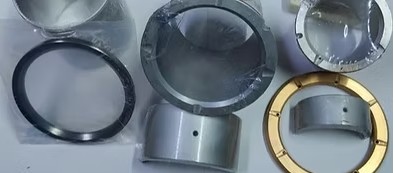
Description
What Is a Compressor Bearing?
A compressor bearing is a mechanical component that supports moving parts and allows controlled relative movement while reducing friction and wear.
In a reciprocating compressor, bearings can be found at several locations depending on the design.
A simplified mechanical arrangement is:
Motor / Prime Mover → Crankshaft → Main Bearings → Crank Pins → Connecting Rods → Crosshead → Piston
Bearings help maintain the correct relationship between these components while carrying the mechanical forces generated during operation.
Main Functions of Bearings
1. Support Rotating Components
Main bearings support the crankshaft and allow it to rotate within the crankcase.
2. Carry Mechanical Loads
Bearings carry radial and, depending on the design, axial loads generated by the crankshaft and connected components.
3. Maintain Alignment
Correct bearing geometry and clearance help maintain crankshaft and connecting-rod alignment.
4. Reduce Friction
The bearing provides a controlled interface between moving components and helps minimize mechanical friction.
5. Support Reliable Compressor Operation
Properly selected and lubricated bearings help reduce wear, heat generation, vibration, and mechanical losses.
Types of Bearings Used in Reciprocating Compressors
The exact bearing arrangement depends on the compressor design. Common bearing categories can include:
Main Crankshaft Bearings
Main bearings support the crankshaft journals within the crankcase.
They are critical for:
- Crankshaft alignment
- Radial load support
- Lubrication
- Stable crankshaft rotation
- Controlling journal clearance
Connecting Rod Bearings
Connecting rod bearings may be used at the crank-pin connection between the crankshaft and connecting rod.
They accommodate the continuous movement and cyclic loading generated by the crank mechanism.
Thrust Bearings
Where required by the compressor design, thrust bearings help control axial movement of the crankshaft or associated rotating components.
Crosshead Bearings / Shoes
Depending on compressor design, the crosshead may use sliding bearing surfaces or shoes rather than conventional rolling bearings.
These components help guide the crosshead and control its movement within the guide.
Bearing Construction
Compressor bearings are designed according to the mechanical loads, speed, lubrication system, and compressor configuration.
Important characteristics can include:
- Bearing diameter
- Bearing width
- Bearing clearance
- Bearing thickness
- Load capacity
- Surface finish
- Bearing material
- Lubrication requirements
- Temperature capability
- Alignment requirements
The exact construction and material should be confirmed against the original compressor engineering specification.
Bearing Materials
Bearing materials depend on the compressor design and operating requirements.
Selection factors include:
- Bearing load
- Compressor speed
- Journal material
- Lubricant type
- Oil viscosity
- Operating temperature
- Lubrication pressure
- Start/stop conditions
- Surface speed
- Expected service life
Depending on the design, compressor bearings may incorporate suitable bearing alloys, lined bearing materials, composite materials, or other engineered bearing constructions.
Material selection should be verified against the original compressor specification rather than based solely on dimensions.
Bearing Lubrication
Proper lubrication is essential for compressor bearing performance.
Depending on the compressor design, bearings may receive lubrication through:
- Pressure lubrication
- Oil pump systems
- Internal crankshaft oil passages
- Splash lubrication
- Manufacturer-specific lubrication arrangements
Lubrication helps:
- Reduce friction
- Remove heat
- Reduce wear
- Protect bearing surfaces
- Support stable operation
Insufficient or contaminated lubrication can significantly reduce bearing service life.
Bearing Clearance
Correct bearing clearance is critical to compressor reliability.
If clearance is excessive, it can contribute to:
- Low oil pressure
- Increased vibration
- Excessive journal movement
- Bearing wear
- Reduced alignment
If clearance is insufficient, it can contribute to:
- Excessive friction
- Heat generation
- Bearing overheating
- Lubrication problems
- Bearing seizure
Bearing clearances should always be established according to the compressor manufacturer’s specifications.
Bearing Inspection
During compressor overhaul, bearings can be inspected for:
- Surface scoring
- Pitting
- Cracks
- Excessive wear
- Discoloration
- Overheating
- Material transfer
- Embedded particles
- Fatigue damage
- Corrosion
- Abnormal contact patterns
- Incorrect clearance
The corresponding crankshaft journals and crank pins should also be inspected because bearing damage may be caused by problems with the mating surfaces.
Signs of Bearing Wear or Failure
Bearing problems may be associated with:
- Increased compressor vibration
- Abnormal crankcase noise
- Bearing overheating
- Low or unstable oil pressure
- Increased crankcase temperature
- Excessive shaft movement
- Metal particles in lubricating oil
- Abnormal journal wear
- Increased mechanical friction
- Compressor shutdown or protection alarms
These symptoms can also originate from lubrication problems, crankshaft damage, misalignment, connecting-rod problems, or other mechanical faults.
A complete mechanical inspection is therefore recommended before replacing bearings.
Causes of Premature Bearing Failure
Potential contributing factors include:
- Insufficient lubrication
- Incorrect lubricant
- Contaminated oil
- Incorrect bearing clearance
- Misalignment
- Excessive loading
- Excessive compressor speed
- Crankshaft journal damage
- Improper installation
- Bearing overheating
- Foreign particles in lubrication system
- Oil supply blockage
- Excessive vibration
Identifying and correcting the underlying cause is important before installing replacement bearings.
Bearing Replacement
Bearings may require replacement during:
- Scheduled compressor overhaul
- Preventive maintenance
- Major inspection
- Bearing wear correction
- Crankshaft replacement
- Connecting-rod overhaul
- Compressor refurbishment
- Mechanical breakdown maintenance
When replacing bearings, the associated crankshaft journals, crank pins, oil passages, bearing housing, lubrication system, and alignment should also be checked.
Bearing Installation Considerations
Correct bearing installation is important for achieving the required service life.
Depending on the compressor design, installation may require verification of:
- Bearing orientation
- Bearing seating
- Bearing clearance
- Journal condition
- Housing dimensions
- Oil-hole alignment
- Lubrication passages
- Fastener torque
- Shaft alignment
- End float
- Contact pattern
Installation procedures and dimensional limits should follow the applicable compressor manufacturer’s instructions.
Bearing Selection Information
For accurate identification of a replacement compressor bearing, provide:
| Parameter | Required Information |
|---|---|
| Compressor Make | Manufacturer / Brand |
| Compressor Model | Exact model number |
| Serial Number | Compressor serial number |
| Bearing Part Number | Existing bearing part number |
| Bearing Type | Main / connecting rod / thrust / other |
| Bearing Location | Applicable position |
| Journal Diameter | Existing journal diameter |
| Bearing OD | Outside diameter |
| Bearing ID | Inside diameter |
| Bearing Width | Bearing width |
| Bearing Thickness | Existing thickness |
| Clearance | Required bearing clearance |
| Crankshaft Model | Applicable crankshaft |
| Compressor Speed | RPM |
| Lubrication | Oil lubrication arrangement |
| Oil Pressure | Operating oil pressure |
| Operating Temperature | Relevant temperature |
| Material | Existing specification, if known |
| Drawing | Original bearing drawing, if available |
Providing the compressor make, model, serial number, existing bearing part number, photographs, dimensions, and original drawings can help identify the correct replacement.
Bearing Inspection During Crankshaft Overhaul
When a crankshaft is inspected or replaced, bearings should also be evaluated.
The inspection may include:
Crankshaft Journal → Bearing Surface → Clearance → Lubrication → Alignment
A new bearing should not be installed without checking the condition of the corresponding crankshaft journal or crank pin.
If the journal has excessive wear, scoring, incorrect dimensions, or other damage, simply replacing the bearing may not resolve the underlying problem.
Applications
Reciprocating compressor bearings are used across:
- Natural Gas Compression
- CNG Compression
- Hydrogen Compression
- Industrial Air Compression
- Process Gas Compression
- Hydrocarbon Gas Compression
- Oil & Gas
- Chemical Processing
- Petrochemical
- Refineries
- Gas Processing
- Gas Storage
- Power Generation
- Industrial Manufacturing
Related Reciprocating Compressor Spare Parts
Aegis Projects can also support associated components including:
- Cylinders
- Pistons
- Piston Rods
- Piston Rings
- Rider Rings
- Distance Pieces
- Rod Packing
- Tangent Rings
- Radial Rings
- Pressure Breaker Rings
- Backup Rings
- Packing Cases
- Oil Scraper Rings
- Crossheads
- Crosshead Shoes
- Connecting Rods
- Crankshafts
- Crank Pins
- Main Bearings
- Cylinder Valves
- Valve Plates
- Valve Springs
- Gaskets
- Seals
- Intercoolers
- Aftercoolers
- Pulsation Dampeners
- Lubrication Components
Aegis Projects – Reciprocating Compressor Bearings
Aegis Projects Technology Pvt. Ltd. supplies replacement bearings and reciprocating compressor spare parts for industrial compressor maintenance, overhaul, refurbishment, and repair requirements.
Bearing requirements can be supported using OEM part numbers, compressor make and model, serial number, bearing dimensions, crankshaft information, original drawings, photographs, samples, and operating conditions.
Because bearing performance depends on the complete mechanical and lubrication system, selection should consider load, speed, journal dimensions, bearing clearance, lubrication, alignment, operating temperature, and compressor configuration.
For critical compressor applications, dimensional inspection and clearance verification should be completed according to the applicable compressor engineering specification before commissioning.
Contact Aegis Projects Technology for reciprocating compressor bearings, crankshaft bearings, connecting-rod bearings, compressor spare parts, and application-specific technical assistance.