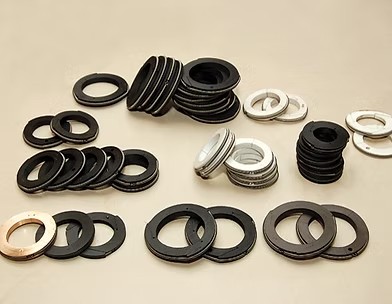
Description
What Is a Backup Ring?
A backup ring is a supporting ring installed behind or adjacent to a primary sealing element.
In a reciprocating compressor packing assembly, the backup ring can provide additional support to the primary sealing component and help maintain its position under pressure.
A simplified sealing arrangement may include:
Cylinder → Primary Packing/Sealing Rings → Backup Ring → Distance Piece
The actual arrangement depends on the compressor and packing design.
Functions of Backup Rings
1. Supports the Primary Seal
The backup ring provides mechanical support to the primary sealing element during compressor operation.
2. Helps Prevent Seal Extrusion
Under high pressure, softer sealing materials can deform or extrude into available clearances. A properly designed backup ring can help restrict this movement.
3. Maintains Sealing Geometry
The ring helps maintain the intended position and geometry of the associated sealing component.
4. Supports High-Pressure Sealing
Backup rings can be particularly useful in sealing systems exposed to elevated pressure, subject to the original design.
5. Improves Packing Reliability
When correctly matched with the primary sealing components, backup rings can contribute to stable sealing performance and reduced premature seal damage.
Backup Ring in Rod Packing Systems
In reciprocating compressors, backup rings may form part of the broader piston rod packing arrangement.
A typical arrangement can include:
- Tangent rings
- Radial rings
- Pressure breaker rings
- Backup rings
- Sealing rings
- Packing rings
- Springs or loading elements, where applicable
- Packing case
- Vent and leakage management connections
Not every compressor uses the same combination of components. The exact packing configuration must therefore be confirmed from the applicable compressor design or packing drawing.
Backup Ring Construction
Backup rings require accurate dimensions and appropriate material selection.
Important characteristics may include:
- Inside diameter
- Outside diameter
- Ring thickness
- Radial clearance
- Axial clearance
- Ring profile
- Split configuration, where applicable
- Surface finish
- Material
- Temperature resistance
- Chemical compatibility
Dimensional requirements should be established from the original compressor or sealing-system specification.
Backup Ring Materials
Material selection depends on the application and the primary sealing material with which the backup ring operates.
Factors include:
- Gas composition
- Operating pressure
- Operating temperature
- Piston rod material
- Seal material
- Compressor speed
- Lubrication conditions
- Chemical compatibility
- Wear requirements
- Required service life
Depending on the design, backup rings may be manufactured from suitable engineered polymers, composite materials, metallic materials, or other specialized materials.
For applications involving natural gas, CNG, hydrogen, hydrocarbon gases, corrosive gases, or high-pressure process gases, material compatibility should be confirmed before replacement.
Backup Rings for High-Pressure Compressors
High-pressure reciprocating compressors can impose significant loads on sealing components.
In such applications, the backup ring may help support the primary seal against pressure-induced deformation.
Selection should consider:
- Maximum pressure differential
- Temperature
- Seal material
- Clearance between mating components
- Piston rod diameter
- Packing case geometry
- Compressor speed
- Gas compatibility
- Lubrication conditions
The backup ring should be selected as part of the complete sealing system rather than as an independent standard component.
Backup Rings for Oil-Free Compressors
Backup rings may also be incorporated into oil-free compressor sealing arrangements where lubrication is limited or absent.
For oil-free applications, attention should be given to:
- Low-friction characteristics
- Material compatibility
- Heat generation
- Piston rod surface finish
- Seal material
- Gas composition
- Pressure
- Temperature
- Compressor speed
- Ring clearance
The complete packing arrangement should be evaluated when replacing backup rings.
Backup Rings for Natural Gas & CNG Compressors
Backup rings may be used in sealing arrangements for:
- CNG compressor skids
- CNG refueling stations
- Natural gas booster compressors
- Gas gathering systems
- Pipeline compression
- Natural gas storage
- Gas transfer systems
- High-pressure reciprocating compressors
For natural gas and CNG applications, correct sealing design is important for controlling leakage and maintaining safe compressor operation.
Backup Rings for Hydrogen Compressors
Hydrogen compression requires careful consideration of sealing materials and component clearances.
Backup ring selection may involve evaluation of:
- Hydrogen compatibility
- Primary seal material
- Ring material
- Pressure
- Temperature
- Piston rod surface finish
- Ring geometry
- Clearance
- Compressor speed
- Leakage requirements
The final ring material and design should be confirmed according to the compressor manufacturer’s engineering specification and the requirements of the hydrogen service.
Signs of Backup Ring or Seal Problems
Problems within a backup-ring or sealing arrangement may be associated with:
- Increased gas leakage
- Primary seal extrusion
- Premature packing wear
- Seal deformation
- Increased packing temperature
- Damaged sealing rings
- Excessive friction
- Abnormal piston rod wear
- Frequent seal replacement
These symptoms can also originate from incorrect clearances, piston rod damage, excessive pressure, incorrect materials, or improper installation.
A complete inspection should therefore be performed before replacing individual components.
Causes of Premature Backup Ring Failure
Potential contributing factors include:
- Incorrect ring dimensions
- Incorrect material
- Excessive pressure
- Excessive temperature
- Incorrect clearance
- Incompatible sealing material
- Damaged piston rod
- Poor surface finish
- Misalignment
- Incorrect installation
- Chemical incompatibility
- Excessive wear
- Incorrect packing configuration
Identifying the underlying cause is important before installing replacement components.
Inspection & Maintenance
During compressor overhaul, backup rings should be inspected for:
- Cracks
- Deformation
- Wear
- Extrusion damage
- Heat damage
- Chemical degradation
- Surface deterioration
- Incorrect clearance
- Ring breakage
- Abnormal contact marks
The associated primary sealing elements, piston rod, packing case, and adjacent packing rings should also be inspected.
Backup Ring Replacement
Backup rings may be replaced during:
- Scheduled compressor overhaul
- Preventive maintenance
- Rod packing replacement
- Seal replacement
- Leakage correction
- Compressor refurbishment
- Breakdown maintenance
- Major inspection
When replacing a backup ring, the associated primary sealing element should also be checked to ensure that both components are compatible.
Replacement should follow the original packing arrangement, ring orientation, dimensions, and specified clearances.
Backup Ring Selection Information
For accurate identification of a replacement backup ring, provide:
| Parameter | Required Information |
|---|---|
| Compressor Make | Manufacturer / Brand |
| Compressor Model | Exact model number |
| Serial Number | Compressor serial number |
| Packing Part Number | Existing packing part number |
| Ring Part Number | Existing backup ring number |
| Cylinder Number | Applicable cylinder / stage |
| Ring Type | Backup ring / sealing arrangement |
| Ring OD | Outside diameter |
| Ring ID | Inside diameter |
| Ring Thickness | Ring thickness |
| Ring Profile | Existing geometry |
| Ring Quantity | Number required |
| Piston Rod Diameter | Rod diameter |
| Primary Seal Material | Existing sealing material |
| Gas | Working medium |
| Suction Pressure | Operating pressure |
| Discharge Pressure | Operating pressure |
| Temperature | Operating temperature |
| Compressor Speed | RPM |
| Lubrication | Oil-free / lubricated |
| Material | Existing specification, if known |
| Drawing | Original packing drawing, if available |
Photographs, physical samples, OEM part numbers, packing drawings, and compressor nameplate information can help identify the correct replacement.
Applications
Backup rings may be used in reciprocating compressor sealing systems across:
- Natural Gas Compression
- CNG Compression
- Hydrogen Compression
- Industrial Air Compression
- Process Gas Compression
- Hydrocarbon Gas Compression
- Oil & Gas
- Chemical Processing
- Petrochemical
- Refineries
- Gas Processing
- Gas Storage
- Power Generation
- Industrial Manufacturing
Related Reciprocating Compressor Spare Parts
Aegis Projects can also support:
- Cylinders
- Pistons
- Piston Rods
- Piston Rings
- Rider Rings
- Distance Pieces
- Rod Packing
- Tangent Rings
- Radial Rings
- Pressure Breaker Rings
- Packing Cases
- Oil Scraper Rings
- Crossheads
- Crosshead Shoes
- Connecting Rods
- Crankshafts
- Cylinder Valves
- Valve Plates
- Valve Springs
- Bearings
- Gaskets
- Seals
- Intercoolers
- Aftercoolers
- Pulsation Dampeners
- Lubrication Components
Aegis Projects – Reciprocating Compressor Sealing Components
Aegis Projects Technology Pvt. Ltd. supplies reciprocating compressor spare parts and replacement sealing components for industrial compressor maintenance, overhaul, and refurbishment.
Backup rings can be supplied based on OEM part numbers, compressor make and model, serial number, original drawings, existing ring dimensions, photographs, samples, and operating conditions.
Because backup-ring terminology and applications can vary between compressor and packing designs, the correct ring should be identified from the original packing arrangement and engineering specification before procurement or installation.
For high-pressure and hazardous gas applications, sealing component replacement should be carried out according to the applicable compressor manufacturer’s procedures and site safety requirements.
Contact Aegis Projects Technology for backup rings, rod packing components, reciprocating compressor spare parts, and application-specific technical assistance.