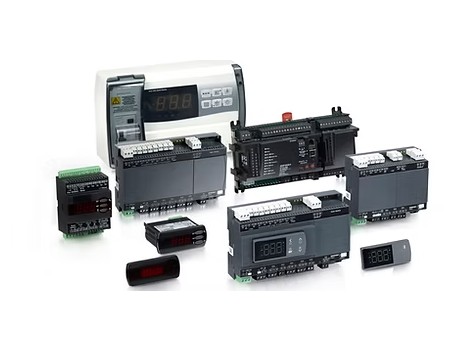
Description
Functions of Evaporator Controllers
Depending on the specific controller and refrigeration-system configuration, an evaporator controller can:
- Monitor evaporator temperature
- Monitor suction pressure
- Control evaporator superheat
- Control electronic expansion valves
- Regulate refrigerant flow
- Control evaporator fans
- Manage defrost cycles
- Control compressor operation where applicable
- Provide temperature alarms
- Detect sensor faults
- Provide digital status information
- Interface with refrigeration monitoring systems
- Support energy-management functions
The exact functions available depend on the controller model, configuration, sensors, actuators, and refrigeration-system architecture.
How an Evaporator Controller Works
An evaporator controller receives information from connected sensors and uses programmed control parameters to operate refrigeration components.
A typical control sequence can be represented as:
Temperature / Pressure Sensors → Evaporator Controller → Expansion Valve / Fan / Defrost / Compressor Control
The controller continuously evaluates operating conditions and adjusts connected components according to the programmed requirements.
For systems using electronic expansion valves, the controller can use evaporator temperature and pressure information to calculate or regulate superheat and command the valve accordingly.
Main Components
An evaporator controller may include:
- Microprocessor or electronic control circuit
- Temperature sensor inputs
- Pressure sensor inputs
- Relay outputs
- Electronic expansion-valve output
- Digital display
- Control buttons
- Communication interface
- Alarm output
- Power-supply terminals
- Sensor and actuator connections
- Mounting enclosure
The exact configuration varies according to the controller model and application.
Evaporator Control Functions
Superheat Control
Controllers can regulate electronic expansion valves to maintain the desired evaporator superheat according to the programmed control strategy.
Fan Control
The controller may operate evaporator fans according to temperature, pressure, cooling demand, defrost status, or other configured conditions.
Defrost Control
Depending on the controller, defrost operation may be initiated and terminated according to time, temperature, sensor input, or other programmed parameters.
Temperature Control
The controller can monitor temperature sensors and maintain the required refrigerated-space or evaporator temperature within the configured control range.
Alarm Management
Controllers may provide alarms for conditions such as:
- High temperature
- Low temperature
- Sensor failure
- Pressure abnormalities
- Defrost faults
- Communication faults
- Other configured system conditions
Applications
Evaporator controllers are commonly used in:
- Commercial refrigeration systems
- Industrial refrigeration systems
- Cold rooms
- Cold storage facilities
- Freezers
- Refrigerated display cabinets
- Food processing refrigeration
- Beverage refrigeration
- Chillers
- Process cooling systems
- Supermarket refrigeration
- HVAC-R equipment
Advantages of Electronic Evaporator Control
Depending on the system design, an electronic evaporator controller can provide:
- Accurate temperature monitoring
- Controlled refrigerant flow
- Improved superheat regulation
- Automated defrost management
- Fan-speed or fan-operation control where supported
- Flexible control parameters
- Alarm and fault monitoring
- Electronic expansion-valve integration
- System-data communication
- Support for energy-management strategies
Actual performance depends on the complete refrigeration system, controller configuration, sensors, and connected components.
Common Evaporator Controller Problems
Controller Does Not Power On
Possible causes include:
- Incorrect power supply
- Loose wiring
- Blown protection device
- Faulty controller
- Incorrect electrical connection
Incorrect Temperature Reading
Possible causes include:
- Faulty temperature sensor
- Incorrect sensor type
- Damaged sensor cable
- Incorrect controller configuration
- Sensor placement problems
Expansion Valve Does Not Respond
Possible causes include:
- Incorrect valve configuration
- Wiring problems
- Faulty valve actuator
- Controller output failure
- Incompatible expansion valve
- Incorrect control parameters
Defrost Problems
Possible causes may include:
- Incorrect defrost settings
- Faulty temperature sensor
- Heater or defrost component failure
- Controller configuration problems
- Wiring or relay problems
Communication Failure
For networked refrigeration systems, communication problems may be caused by:
- Incorrect communication settings
- Wiring problems
- Addressing errors
- Connector problems
- Controller faults
- Network or system integration issues
Sensors Used with Evaporator Controllers
Depending on the application, an evaporator controller may receive information from:
- Evaporator temperature sensors
- Air temperature sensors
- Suction temperature sensors
- Pressure transducers
- Defrost sensors
- Refrigerated-space sensors
Correct sensor type and compatibility are essential for accurate control.
Installation Considerations
Correct installation is important for reliable evaporator-controller operation.
Important considerations include:
- Confirm controller compatibility with the refrigeration system
- Verify supply voltage
- Use compatible sensors
- Connect pressure transducers correctly where applicable
- Match expansion-valve compatibility
- Follow wiring diagrams
- Configure temperature and pressure parameters correctly
- Protect electrical connections from moisture
- Install the controller in a suitable environment
- Follow manufacturer commissioning procedures
Electrical installation should be performed using appropriate safety procedures.
Inspection & Maintenance
Regular inspection helps maintain reliable electronic refrigeration control.
Checks may include:
- Verify controller power supply
- Inspect electrical terminals
- Check sensor connections
- Verify temperature readings
- Check pressure-sensor signals
- Inspect expansion-valve operation
- Check fan and defrost outputs
- Review alarm history where available
- Inspect communication connections
- Verify programmed parameters
- Check the controller display and keypad
- Replace faulty sensors or controllers where required
Evaporator Controller Selection Parameters
| Parameter | Requirement |
|---|---|
| Application | Refrigeration / HVAC-R |
| Controller Type | Evaporator controller |
| Refrigeration System | Commercial / industrial / cold storage / other |
| Supply Voltage | According to model |
| Temperature Inputs | Application-specific |
| Pressure Inputs | Where applicable |
| Expansion Valve Output | Required where EEV is used |
| Fan Control | Required / not required |
| Defrost Control | Required / not required |
| Relay Outputs | According to application |
| Alarm Outputs | As required |
| Communication | Digital / network / other |
| Sensor Compatibility | Required |
| Refrigerant | System-specific |
| Display | Required / not required |
| Operating Temperature | Application-specific |
| Mounting | Panel / enclosure / equipment-specific |
| Manufacturer | As specified |
| Part Number | Required for exact replacement |
Replacement Considerations
When replacing an evaporator controller, compatibility should be checked across the complete refrigeration-control system.
Important details include:
- Original controller part number
- Refrigeration equipment model
- Refrigerant type
- Supply voltage
- Sensor type
- Pressure-transducer compatibility
- Expansion-valve compatibility
- Number and type of outputs
- Defrost requirements
- Fan-control requirements
- Communication protocol
- Programming requirements
- Mounting configuration
A controller should not be selected solely based on physical dimensions because electrical, sensor, valve, and software compatibility are equally important.
Why Choose Aegis Projects?
Aegis Projects Technology supplies evaporator controllers and electronic refrigeration-control components for commercial, industrial, cold-storage, chiller, and HVAC-R applications.
We can assist with replacement selection based on:
- Original controller part number
- Refrigeration equipment model
- Refrigerant
- Sensor configuration
- Electronic expansion-valve requirements
- Fan and defrost control
- Electrical specifications
- Communication requirements
- Installation configuration
Contact Aegis Projects Technology for evaporator controllers and other refrigeration spare parts.