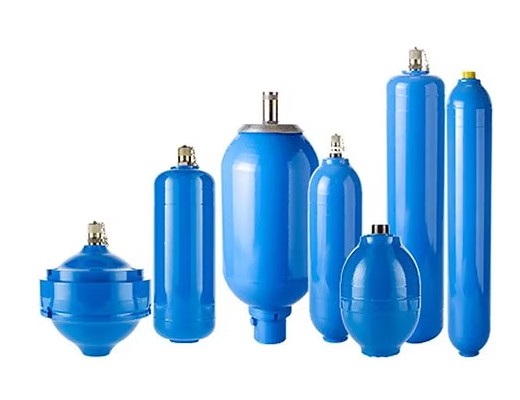
Description
Functions of a Hydraulic Accumulator
A hydraulic accumulator can perform several important functions within a hydraulic circuit:
- Store pressurised hydraulic energy
- Provide supplementary flow during peak demand
- Maintain hydraulic system pressure
- Reduce pressure pulsations
- Absorb hydraulic shocks and pressure surges
- Compensate for small pressure losses
- Support emergency or standby hydraulic operation
- Reduce pump cycling in suitable applications
- Improve hydraulic actuator response
- Help dampen vibrations and pressure fluctuations
- Compensate for thermal expansion of hydraulic fluid where applicable
Working Principle
A hydraulic accumulator stores energy by using hydraulic fluid to compress a gas, typically nitrogen, inside a pressure vessel.
During charging, hydraulic fluid enters the accumulator and compresses the gas. The compressed gas stores potential energy.
When the hydraulic system requires additional flow or pressure support, the compressed gas expands and forces stored hydraulic fluid back into the hydraulic circuit.
The basic operating sequence is:
Hydraulic Pump → Accumulator Charging → Gas Compression → Energy Storage → Hydraulic Demand → Gas Expansion → Stored Fluid Discharge
The accumulator therefore acts as a buffer between hydraulic energy generation and hydraulic energy demand.
Types of Hydraulic Accumulators
Bladder Accumulators
Bladder accumulators use a flexible bladder to separate hydraulic fluid from the pre-charged gas. They are widely used because of their fast response and ability to handle pressure fluctuations.
Piston Accumulators
Piston accumulators use a movable piston to separate the hydraulic fluid from the gas chamber. They are suitable for applications requiring larger fluid volumes and specific energy-storage characteristics.
Diaphragm Accumulators
Diaphragm accumulators use a flexible diaphragm to separate the gas and hydraulic fluid. They are generally used where compact energy storage and rapid response are required.
Metal-Bellows or Specialised Accumulators
Specialised accumulator designs may use alternative separation mechanisms for particular industrial applications, depending on operating conditions and system requirements.
Main Components
Depending on accumulator design, construction may include:
- Pressure vessel
- Bladder, piston or diaphragm
- Gas charging valve
- Hydraulic connection
- Gas chamber
- Hydraulic chamber
- Sealing elements
- Piston seals
- Backup rings
- O-rings
- Protective components
- Mounting accessories
- Safety or pressure protection accessories where required
Hydraulic Accumulator Spare Parts
Aegis Projects can also supply replacement components associated with hydraulic accumulators, depending on the accumulator design and model.
Common replacement items include:
- Accumulator bladders
- Diaphragms
- Piston seals
- O-rings
- Backup rings
- Sealing kits
- Gas valves
- Charging valves
- Hydraulic connection components
- Mounting accessories
- Repair kits
- Service kits
Replacement parts should be selected according to the accumulator model, dimensions, pressure rating, hydraulic fluid compatibility and manufacturer specifications.
Applications
Hydraulic accumulators are used across a wide range of industrial and mobile hydraulic systems, including:
- Hydraulic power packs
- Hydraulic presses
- Injection moulding machines
- Industrial automation equipment
- Hydraulic lifting systems
- Material-handling equipment
- Mobile hydraulic machinery
- Construction equipment
- Machine tools
- Steel and metal processing equipment
- Plastic processing machinery
- Oil and gas equipment
- Energy and power equipment
- Marine hydraulic systems
- Hydraulic clamping systems
- Emergency hydraulic systems
- Industrial automation systems
Energy Storage and Peak Flow Support
One of the main applications of an accumulator is to provide additional hydraulic flow during periods of high demand.
Instead of sizing the hydraulic pump solely for short-duration peak flow requirements, an appropriately selected accumulator can store energy during lower-demand periods and release it when the system requires additional flow.
This can help:
- Reduce instantaneous pump loading
- Support peak actuator demand
- Improve system response
- Reduce pressure fluctuations
- Improve overall hydraulic system operation
The actual suitability depends on the hydraulic circuit and operating cycle.
Pressure Stabilisation
Hydraulic accumulators can help stabilise system pressure by absorbing fluctuations caused by changes in flow demand, valve operation and actuator movement.
They can also help reduce pressure pulsations generated by hydraulic pumps and minimise sudden pressure changes within the hydraulic circuit.
Shock and Surge Absorption
Rapid movement of hydraulic valves or actuators can produce pressure surges and hydraulic shock.
An accumulator can act as a hydraulic buffer, absorbing part of these transient pressure changes and helping protect:
- Hydraulic pumps
- Valves
- Cylinders
- Hoses
- Pipes
- Fittings
- Instrumentation
- Other hydraulic components
Pre-Charge Pressure
The gas pre-charge is an important operating parameter for a hydraulic accumulator.
The appropriate pre-charge depends on the accumulator application, operating pressure, required usable volume and operating cycle.
Incorrect pre-charge can affect accumulator performance and may contribute to problems such as:
- Reduced usable volume
- Poor pressure support
- Excessive bladder movement
- Premature component wear
- Unstable hydraulic performance
Pre-charge should therefore be checked and maintained according to the accumulator and system manufacturer’s specified procedure.
Hydraulic Fluid Compatibility
The accumulator’s internal sealing materials and construction must be compatible with the hydraulic fluid being used.
Before replacement or installation, verify compatibility with:
- Hydraulic oil type
- Operating temperature
- Pressure conditions
- Seal material
- Bladder or diaphragm material
- Process or application requirements
Common Hydraulic Accumulator Problems
Common issues may include:
- Loss of gas pre-charge
- Bladder failure
- Damaged diaphragm
- Piston seal wear
- Hydraulic leakage
- Gas leakage
- Damaged charging valve
- Internal contamination
- Corrosion
- Incorrect pre-charge
- Excessive pressure cycling
- Incorrect accumulator sizing
- Damaged hydraulic connection
- Abnormal pressure fluctuations
Inspection and Maintenance
Regular inspection helps maintain accumulator performance and system reliability.
Recommended checks include:
- Check for external hydraulic leakage
- Inspect the accumulator body for damage or corrosion
- Check gas pre-charge according to the specified maintenance procedure
- Inspect charging valves and connections
- Check mounting arrangements
- Inspect hydraulic connections
- Examine hoses and fittings connected to the accumulator
- Monitor abnormal pressure fluctuations
- Replace damaged seals and service components
- Maintain appropriate hydraulic fluid cleanliness
Accumulator servicing should only be carried out using appropriate pressure-release and safety procedures.
Installation Considerations
Before installing a hydraulic accumulator, verify:
- Accumulator pressure rating
- Required volume
- Gas type and pre-charge requirements
- Hydraulic fluid compatibility
- Operating temperature
- Hydraulic connection size
- Installation orientation
- Mounting arrangement
- Available space
- System pressure
- Required flow characteristics
The accumulator must be securely mounted and protected from mechanical impact, excessive vibration and unsuitable environmental conditions.
Hydraulic Accumulator Selection Guide
| Specification | Requirement |
|---|---|
| Accumulator Type | Bladder / Piston / Diaphragm / Application-specific |
| Nominal Volume | As required by hydraulic circuit |
| Operating Pressure | As per system requirement |
| Maximum Allowable Pressure | According to accumulator specification |
| Pre-Charge Pressure | According to application and manufacturer specification |
| Hydraulic Fluid | Compatible hydraulic fluid |
| Operating Temperature | According to seal and accumulator specification |
| Hydraulic Connection | As required |
| Mounting | Vertical / Horizontal / Application-specific |
| Material | According to pressure, fluid and environment |
| Seal Material | According to hydraulic fluid and temperature |
| Application | Hydraulic power pack / machinery / industrial system |
| Replacement Requirement | Model and specification dependent |
Replacement Hydraulic Accumulators
When replacing an existing accumulator, matching the original component only by physical size may not be sufficient.
The replacement should be checked against:
- Accumulator type
- Nominal volume
- Operating pressure
- Maximum allowable pressure
- Pre-charge requirements
- Hydraulic connection
- Seal material
- Hydraulic fluid
- Operating temperature
- Installation arrangement
- Application duty cycle
Aegis Projects can assist in identifying suitable replacement accumulators and associated service components based on available equipment details.
Why Choose Aegis Projects?
Aegis Projects Technology provides industrial hydraulic components and spare parts for hydraulic systems and machinery. Our hydraulic accumulator solutions can be selected according to application requirements, system specifications and equipment configuration.
We support requirements for:
- Hydraulic accumulators
- Accumulator spare parts
- Bladder replacement
- Seal kits
- Charging components
- Hydraulic system components
- Industrial hydraulic spare parts
- Replacement and maintenance requirements
Request a Hydraulic Accumulator
For hydraulic accumulator requirements, replacement parts or technical assistance, contact Aegis Projects Technology with the accumulator model, system pressure, application details and available equipment specifications.
Aegis Projects – Hydraulic Components and Industrial Spare Parts for Reliable Hydraulic Systems.