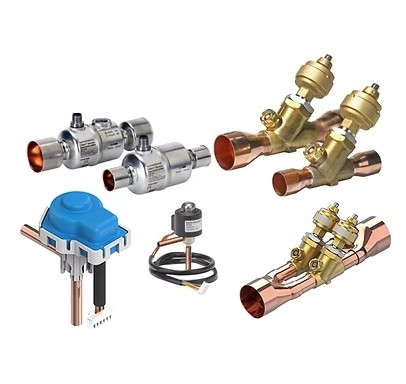
Description
Function of an Electronic Expansion Valve
An EEV controls the quantity of refrigerant entering the evaporator according to signals received from the refrigeration control system.
Its functions may include:
- Precisely regulating refrigerant flow
- Controlling evaporator superheat
- Matching refrigerant flow to changing cooling loads
- Improving evaporator utilization
- Supporting stable refrigeration operation
- Reducing the risk of excessive liquid refrigerant reaching the compressor
- Supporting energy-efficient system operation
- Providing accurate flow control during varying operating conditions
The actual control strategy depends on the electronic controller, sensors, valve type, and refrigeration-system design.
How an Electronic Expansion Valve Works
An electronic expansion valve typically uses a stepper motor or other electrically controlled actuator to position an internal valve element.
A refrigeration controller receives information from sensors such as:
- Evaporator temperature sensor
- Suction pressure sensor
- Refrigerant temperature sensor
- Pressure transducer
The controller calculates the required valve position and sends an electrical signal to the EEV actuator.
A simplified control sequence is:
Temperature / Pressure Sensors → Electronic Controller → EEV Actuator → Valve Position → Refrigerant Flow
The valve can be opened or closed in controlled increments, allowing precise adjustment of refrigerant flow.
Main Components
Depending on the EEV design, the assembly may include:
- Valve body
- Valve seat
- Valve needle or flow-control element
- Stepper motor or actuator
- Motor winding
- Rotor and stator arrangement
- Electrical connector
- Internal seals
- Inlet and outlet connections
Some systems use a separate electronic driver between the controller and the valve.
Types of Electronic Expansion Valves
Stepper-Motor Expansion Valves
These valves use controlled motor steps to position the internal valve element accurately.
Pulse-Controlled Expansion Valves
Some electronic refrigeration systems use pulse-based actuation to regulate refrigerant flow.
Modulating Electronic Expansion Valves
These valves continuously adjust their opening according to the controller’s output and changing refrigeration conditions.
Bidirectional Electronic Expansion Valves
Certain EEV designs are suitable for systems where refrigerant flow can reverse, such as heat-pump applications, subject to manufacturer specifications.
Electronic Expansion Valve vs. Thermostatic Expansion Valve
| Feature | Electronic Expansion Valve | Thermostatic Expansion Valve |
|---|---|---|
| Control Method | Electronic | Mechanical |
| Actuation | Motor / electrical actuator | Thermal sensing mechanism |
| Sensor Requirement | Electronic sensors generally required | Sensing bulb and pressure response |
| Flow Adjustment | Precise electronic positioning | Mechanical modulation |
| Response | Controller-dependent and potentially rapid | Mechanical response |
| Superheat Control | Electronic algorithm | Mechanical valve response |
| Integration | Controller / PLC / electronic system | Primarily mechanical |
| Application | Advanced refrigeration systems | Conventional refrigeration systems |
The appropriate valve depends on the refrigeration-system design and control architecture.
Refrigerant Compatibility
Electronic expansion valves must be selected according to the refrigerant used in the refrigeration system.
Important compatibility considerations include:
- Refrigerant type
- Operating pressure
- Evaporating temperature
- Condensing pressure
- Refrigeration capacity
- Valve flow characteristics
- Internal material compatibility
- Seal compatibility
A valve designed for one application should not automatically be substituted into another refrigeration system without verifying the manufacturer’s specifications.
Applications
Electronic expansion valves are used in:
- Commercial refrigeration systems
- Industrial refrigeration systems
- Cold rooms
- Cold storage equipment
- Freezers
- Refrigerated display cabinets
- Chillers
- Heat pumps
- Air-conditioning systems
- Food processing refrigeration
- Beverage refrigeration
- Process cooling systems
- Precision temperature-control systems
- HVAC-R equipment
Advantages of Electronic Expansion Valves
Depending on the system design, EEVs can provide:
- Precise refrigerant-flow control
- Improved superheat regulation
- Fast response to load changes
- Improved evaporator utilization
- Flexible electronic control
- Integration with refrigeration controllers
- Improved control during low-load conditions
- Support for energy-management strategies
- Accurate control over a wide operating range
Actual energy and performance benefits depend on the complete refrigeration-system design and control strategy.
Common Electronic Expansion Valve Problems
Valve Does Not Move
Possible causes include:
- No power to actuator
- Incorrect wiring
- Failed actuator
- Faulty controller
- Damaged motor winding
- Mechanical obstruction
- Incorrect control signal
Incorrect Refrigerant Flow
Possible causes include:
- Incorrect valve selection
- Incorrect controller configuration
- Faulty temperature or pressure sensors
- Incorrect valve positioning
- Contamination
- Mechanical damage
Unstable Superheat
Unstable superheat may be associated with:
- Incorrect control parameters
- Sensor problems
- Incorrect valve sizing
- Refrigerant-system instability
- Poor sensor placement
- Controller or communication issues
Valve Stuck or Restricted
Possible causes include:
- Dirt or debris
- Moisture or ice
- Internal mechanical damage
- Corrosion
- Improper installation
- Refrigerant-system contamination
Sensors and Controller Integration
An electronic expansion valve normally works as part of a larger electronic control system.
A typical arrangement may include:
Pressure Sensor + Temperature Sensor → Refrigeration Controller → EEV Driver → Electronic Expansion Valve
The controller uses measured system conditions to determine the required valve position.
Correct compatibility between the EEV, controller, sensors, and driver is essential for reliable operation.
Installation Considerations
Correct installation is important for reliable EEV operation.
Important considerations include:
- Select an EEV compatible with the refrigerant
- Match the valve capacity to the refrigeration load
- Confirm the actuator and controller compatibility
- Follow the specified refrigerant-flow direction
- Match electrical requirements
- Use the correct connectors and wiring
- Protect the valve from excessive heat during brazing
- Keep the refrigeration circuit clean
- Prevent moisture and contaminants from entering the system
- Install sensors at the locations specified by the control-system design
- Follow manufacturer commissioning procedures
Inspection & Maintenance
Electronic expansion valves generally require system-level inspection rather than routine mechanical adjustment.
Checks may include:
- Inspect electrical connections
- Check actuator wiring
- Verify controller communication
- Check temperature and pressure sensors
- Monitor valve position
- Check evaporator superheat
- Inspect for refrigerant leakage
- Check for contamination
- Verify correct valve operation
- Check controller parameters
- Inspect connectors for moisture or corrosion
Any controller or valve configuration should be checked against the equipment manufacturer’s specifications.
Electronic Expansion Valve Selection Parameters
| Parameter | Requirement |
|---|---|
| Application | Refrigeration / HVAC-R |
| Valve Type | Electronic expansion valve |
| Actuation | Stepper motor / electronic actuator |
| Refrigerant | System-specific |
| Refrigeration Capacity | Application-specific |
| Flow Capacity | According to system |
| Operating Pressure | System-specific |
| Evaporating Temperature | Application-specific |
| Condensing Conditions | Application-specific |
| Valve Position Control | Controller-specific |
| Controller Compatibility | Required |
| Driver Compatibility | Where applicable |
| Electrical Supply | According to model |
| Connection Type | Solder / brazed / other |
| Flow Direction | As specified |
| Temperature Range | Application-specific |
| Manufacturer / Part Number | Required for exact replacement |
Replacement Considerations
When replacing an electronic expansion valve, compatibility must be checked across the complete control system.
Important information includes:
- Original EEV part number
- Refrigeration equipment model
- Refrigerant type
- Refrigeration capacity
- Operating pressure
- Valve flow capacity
- Actuator type
- Controller model
- Driver type
- Electrical requirements
- Connection size
- Flow direction
- Temperature range
A physically compatible valve may still be electrically or electronically incompatible with the existing controller.
Why Choose Aegis Projects?
Aegis Projects Technology supplies electronic expansion valves and refrigeration flow-control components for commercial, industrial, cold-storage, chiller, heat-pump, and HVAC-R applications.
We can assist with replacement selection based on:
- Original valve part number
- Refrigeration equipment model
- Refrigerant
- Cooling capacity
- Valve capacity
- Operating pressure
- Actuator type
- Controller compatibility
- Electrical requirements
- Connection configuration
Contact Aegis Projects Technology for electronic expansion valves and other refrigeration spare parts.