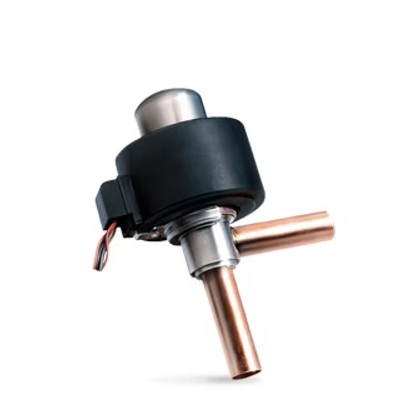
Description
Functions of an Electronic Expansion Valve
An electronic expansion valve can perform several important functions within a refrigeration system:
- Controls refrigerant flow into the evaporator
- Maintains required evaporator operating conditions
- Supports electronic superheat control
- Adjusts refrigerant flow according to cooling load
- Improves evaporator utilization
- Helps prevent excessive liquid refrigerant from reaching the compressor
- Supports stable refrigeration operation
- Allows precise flow modulation
- Supports variable-load refrigeration systems
- Integrates with electronic refrigeration controllers
- Supports energy-efficient system control strategies
How an Electronic Expansion Valve Works
An EEV operates as part of an electronic refrigeration control system.
Temperature and pressure sensors provide information about the refrigeration system to an electronic controller. The controller processes this information and sends a control signal to the expansion valve actuator.
The actuator then changes the valve opening to increase or decrease refrigerant flow into the evaporator.
A typical control arrangement is:
Temperature / Pressure Sensors → Electronic Controller → EEV Actuator → Refrigerant Flow
When the refrigeration load changes, the controller can adjust the valve position to maintain the required operating conditions.
Main Components
Depending on the design and manufacturer, an electronic expansion valve may include:
- Valve body
- Valve seat
- Needle, pin, or flow-control element
- Stepper motor or electronic actuator
- Drive mechanism
- Electrical connector
- Refrigerant inlet and outlet connections
- Sealing components
- Internal guides
- Mounting components
The construction and materials vary according to the valve design, refrigerant, pressure rating, temperature range, and application.
Types of Electronic Expansion Valves
1. Stepper Motor Expansion Valves
Stepper-motor-driven valves can provide precise positioning through controlled motor steps. They are commonly integrated with electronic refrigeration controllers.
2. Modulating Electronic Expansion Valves
These valves continuously adjust refrigerant flow according to the control signal and changing refrigeration conditions.
3. Pulse-Controlled Expansion Valves
Some systems use electronically controlled pulsing to regulate refrigerant flow. The operating method depends on the valve and controller design.
4. Bidirectional Electronic Expansion Valves
Certain EEV designs can control refrigerant flow in both directions and may be used in systems requiring reversible refrigeration or heat-pump operation.
Bidirectional operation should only be assumed when specifically supported by the valve design.
Electronic Expansion Valve vs. Thermostatic Expansion Valve
| Feature | Electronic Expansion Valve | Thermostatic Expansion Valve |
|---|---|---|
| Control Method | Electronic | Mechanical |
| Actuation | Motor / Electronic Actuator | Diaphragm and sensing element |
| Flow Adjustment | Electronically controlled | Thermostatically controlled |
| Sensor Requirement | Normally requires electronic control inputs | Uses sensing bulb and related components |
| Response | Can provide rapid modulation | Depends on mechanical response |
| Controller Integration | Designed for electronic control | Generally independent of electronic controller |
| Variable Load Control | Well suited | Suitable depending on application |
| Superheat Control | Electronic | Mechanical |
| System Integration | High | Lower |
| Application | Modern electronically controlled systems | Conventional refrigeration systems |
The appropriate valve depends on the refrigeration system design and control architecture.
Electronic Expansion Valve Applications
Electronic expansion valves are used in:
- Commercial refrigeration systems
- Industrial refrigeration systems
- Cold rooms
- Cold storage facilities
- Freezer systems
- Refrigerated display cabinets
- Supermarket refrigeration
- Chillers
- HVAC-R systems
- Process cooling systems
- Food and beverage refrigeration
- Pharmaceutical refrigeration
- Heat-pump systems where compatible
- Multi-evaporator refrigeration systems
- Variable-load refrigeration systems
EEV and Superheat Control
One important application of an electronic expansion valve is electronic superheat control.
The controller can use temperature and pressure measurements to determine the operating condition of the refrigerant at the evaporator outlet. Based on the programmed control strategy, it adjusts the EEV opening to regulate refrigerant flow.
This allows the system to respond to changing cooling loads and helps maintain the intended evaporator operating conditions.
The exact control method depends on the controller, sensors, refrigerant, valve characteristics, and system design.
Advantages of Electronic Expansion Valves
Depending on the complete system design, EEVs can provide:
- Precise refrigerant flow control
- Rapid response to changing load conditions
- Accurate electronic superheat control
- Improved evaporator utilization
- Integration with digital refrigeration controllers
- Flexible operating control
- Suitable operation across varying load conditions
- Support for automated refrigeration systems
- Detailed system monitoring when integrated with electronic controls
Actual system efficiency depends on the complete refrigeration system, control strategy, compressor, condenser, evaporator, refrigerant, operating conditions, and component selection.
Common Electronic Expansion Valve Problems
Incorrect operation or component failure can result in refrigeration performance problems.
Common issues include:
- Valve not opening
- Valve remaining open
- Restricted refrigerant flow
- Incorrect valve positioning
- Stepper motor or actuator failure
- Electrical connection problems
- Controller communication problems
- Incorrect sensor readings
- Incorrect valve configuration
- Refrigerant leakage
- Excessive superheat
- Insufficient superheat
- Unstable refrigeration operation
- Incorrect valve sizing
A valve fault should be evaluated together with the controller, sensors, wiring, refrigerant charge, and other refrigeration components.
Inspection and Maintenance
Inspection of an electronic expansion valve system may include:
- Checking electrical connections
- Inspecting the valve body for damage
- Checking refrigerant connections for leakage
- Verifying controller operation
- Checking temperature sensors
- Checking pressure sensors
- Confirming valve configuration
- Checking actuator response
- Monitoring superheat
- Inspecting wiring and connectors
- Checking for abnormal temperature or pressure conditions
The valve should be tested according to the manufacturer’s technical specifications and the refrigeration controller’s operating procedure.
Installation Considerations
Proper installation is important for reliable EEV operation.
Consider the following:
- Confirm that the valve is suitable for the refrigerant.
- Verify the valve capacity for the application.
- Confirm inlet and outlet orientation.
- Follow the manufacturer’s flow-direction requirements.
- Ensure compatible electrical connections.
- Use suitable refrigeration tubing and fittings.
- Prevent contamination from entering the refrigeration circuit.
- Protect the valve from excessive heat during brazing.
- Check all connections for leakage after installation.
- Configure the controller according to the valve characteristics.
- Verify sensor placement and operation.
- Check system superheat after commissioning.
Electronic Expansion Valve Selection
The correct EEV should be selected according to the complete refrigeration system and its control requirements.
| Specification | Requirement |
|---|---|
| Application | Refrigeration / HVAC-R / Chiller / Process Cooling |
| Valve Type | Electronic Expansion Valve |
| Actuation | Stepper Motor / Electronic Actuator / Other |
| Refrigerant | Application Specific |
| Refrigerant Capacity | According to System Load |
| Flow Capacity | According to Operating Conditions |
| Evaporating Temperature | Application Specific |
| Condensing Temperature | Application Specific |
| Operating Pressure | According to System |
| Differential Pressure | Application Specific |
| Control Method | Controller / Driver Specific |
| Superheat Control | Electronic |
| Valve Size | According to Required Capacity |
| Connections | As Required |
| Flow Direction | According to Valve Design |
| Electrical Supply | According to Actuator / Driver |
| Connector | Controller Compatible |
| Temperature Range | Application Specific |
| Installation | Inline / System Specific |
| Manufacturer / Part Number | As Required |
Replacement Considerations
When replacing an electronic expansion valve, the replacement should be matched to the complete control system rather than selected only by physical dimensions.
Verify:
- Existing valve model and part number
- Refrigerant compatibility
- Required refrigeration capacity
- Valve flow characteristics
- Operating pressure
- Evaporating and condensing conditions
- Actuator type
- Controller compatibility
- Electrical specifications
- Connector configuration
- Pipe connections
- Flow direction
- Temperature range
The controller and EEV should be compatible with each other. An electrically compatible valve may still be unsuitable if its flow characteristics or control requirements differ from the original system.
Electronic Expansion Valve Supplier – Aegis Projects
Aegis Projects Technology Pvt. Ltd. supplies electronic expansion valves and refrigeration control components for commercial and industrial refrigeration applications.
Our refrigeration spare-parts range includes electronic expansion valves, thermostatic expansion valves, solenoid valves, pressure switches, temperature sensors, evaporator controllers, filter driers, sight glasses, check valves, and other refrigeration components.
Electronic expansion valves can be selected according to the refrigerant, refrigeration capacity, operating conditions, controller compatibility, valve configuration, and application requirements.
Contact Aegis Projects for electronic expansion valves and compatible refrigeration control components for your refrigeration system.