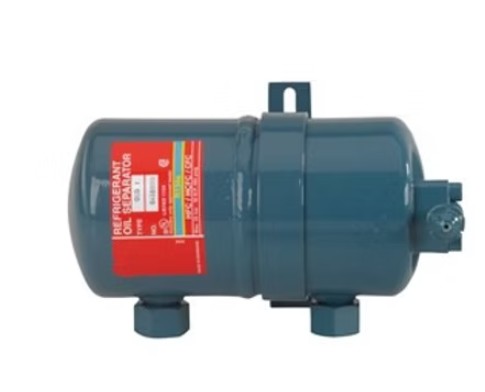
Description
Function of an Oil Separator
The primary purpose of an oil separator is to separate compressor oil from the refrigerant discharge stream.
Its functions may include:
- Separating oil from hot refrigerant discharge gas
- Returning separated oil to the compressor
- Reducing oil circulation through the refrigeration circuit
- Supporting proper compressor oil level
- Helping maintain compressor lubrication
- Reducing oil accumulation in evaporators and other system components
- Supporting reliable refrigeration-system operation
The effectiveness of an oil separator depends on its design, operating conditions, refrigerant, oil type, compressor arrangement, and system installation.
How an Oil Separator Works
Hot refrigerant gas containing entrained compressor oil enters the oil separator from the compressor discharge line.
Inside the separator, changes in flow velocity and direction allow oil droplets to separate from the refrigerant gas.
The separated oil collects in the lower section of the separator and is returned toward the compressor through the appropriate oil-return arrangement.
A simplified flow path is:
Compressor Discharge → Oil Separator → Separated Refrigerant → Condenser
while:
Separated Oil → Oil Return → Compressor
The exact internal separation and oil-return mechanism depends on the specific OUB design.
Main Components
Depending on the oil separator design, an OUB assembly may include:
- Separator housing
- Refrigerant inlet
- Refrigerant outlet
- Internal separation chamber
- Oil collection area
- Oil-return connection
- Internal baffle or separation arrangement
- Oil-return mechanism
- Check or float mechanism where applicable
- Sealing components
Construction materials and internal arrangements vary according to the manufacturer, refrigerant, pressure rating, temperature range, and application.
Importance of Oil Separation
Compressor oil naturally circulates with refrigerant in many refrigeration systems. Excessive oil circulation can result in oil accumulating in parts of the refrigeration circuit.
An appropriately selected oil separator can help:
- Maintain compressor oil availability
- Reduce oil migration
- Improve oil return
- Limit oil accumulation in evaporators
- Support heat-transfer performance
- Reduce lubrication-related risks
- Improve oil-management stability
An oil separator does not replace correct compressor oil selection, system design, refrigerant charging, piping design, or proper oil-return practices.
Applications
Oil separators can be used in:
- Commercial refrigeration systems
- Industrial refrigeration systems
- Cold rooms
- Cold storage plants
- Freezers
- Chillers
- Food processing refrigeration
- Beverage refrigeration
- Process cooling systems
- Multi-compressor refrigeration systems
- Parallel compressor systems
- Low-temperature refrigeration applications
- HVAC-R systems
Oil Separator in Multi-Compressor Systems
Oil separators can be particularly useful in systems where multiple compressors operate together.
A suitable oil-management arrangement can help separate oil from the common discharge stream and return it to the appropriate compressor oil circuit.
The exact oil-return arrangement depends on the compressor configuration and refrigeration-system design.
Common Oil Separator Problems
Poor Oil Separation
Reduced separation performance may be associated with:
- Incorrect sizing
- Unsuitable operating conditions
- Excessive refrigerant velocity
- Incorrect installation
- Internal damage
- Excessive oil carryover
Oil Not Returning to Compressor
Possible causes include:
- Blocked oil-return passage
- Faulty oil-return mechanism
- Incorrect piping arrangement
- Incorrect pressure conditions
- Contamination
- Incorrect installation
Excessive Oil in Refrigeration Circuit
Oil accumulation in evaporators or other components can affect system operation and may indicate an oil-management problem.
Possible causes include:
- Inadequate oil return
- Incorrect piping
- Incorrect oil separator selection
- Operating conditions outside the intended range
- Compressor or system-related issues
Refrigerant Leakage
Leakage may occur at:
- Pipe connections
- Brazed joints
- Sealing surfaces
- Oil-return connections
- Damaged separator body
Inspection & Maintenance
Regular inspection can help maintain proper oil-management performance.
Checks may include:
- Inspect separator body for damage
- Check for refrigerant or oil leakage
- Inspect inlet and outlet connections
- Check oil-return piping
- Verify the oil-return path is not restricted
- Inspect associated valves or mechanisms where applicable
- Check compressor oil level and condition
- Monitor system performance
- Inspect for excessive oil accumulation in the refrigeration circuit
Oil-separator servicing should be performed according to the equipment manufacturer’s requirements and applicable refrigeration-service procedures.
Installation Considerations
Correct installation is important for reliable oil-separator operation.
Important considerations include:
- Select the separator for the refrigeration system and compressor arrangement
- Confirm refrigerant compatibility
- Confirm oil compatibility
- Install according to the specified refrigerant flow direction
- Connect the oil-return line correctly
- Maintain appropriate piping arrangement
- Avoid excessive vibration and mechanical stress
- Follow the manufacturer’s installation requirements
- Check all connections for leakage after installation
Incorrect oil-return piping can affect separator performance even when the separator itself is correctly sized.
Oil Separator Selection Parameters
| Parameter | Requirement |
|---|---|
| Application | Refrigeration / HVAC-R |
| Component | Oil Separator (OUB) |
| Refrigerant | System-specific |
| Compressor Type | According to application |
| Refrigeration Capacity | Application-specific |
| Refrigerant Flow Rate | Required system flow |
| Oil Type | Compressor/system-specific |
| Connection Size | According to piping |
| Connection Type | Solder / brazed / threaded / other |
| Operating Pressure | System-specific |
| Pressure Rating | According to system |
| Temperature Range | Application-specific |
| Oil Return Arrangement | As specified |
| Installation Position | According to manufacturer |
| Body Material | As specified |
| Manufacturer | As specified |
| Part Number | Required for exact replacement |
Replacement Considerations
When replacing an Oil Separator (OUB), compatibility should be verified using the original component information and refrigeration-system requirements.
Important details include:
- Original OUB part number
- Refrigeration equipment model
- Compressor model
- Refrigerant type
- Compressor oil type
- Refrigeration capacity
- Discharge-line connection size
- Oil-return arrangement
- Operating pressure
- Temperature range
- Installation orientation
A replacement oil separator should not be selected solely by physical dimensions or pipe size.
Why Choose Aegis Projects?
Aegis Projects Technology supplies Oil Separators (OUB) and refrigeration oil-management components for commercial, industrial, cold-storage, and HVAC-R applications.
We can assist with replacement selection based on:
- Original part number
- Compressor model
- Refrigeration equipment
- Refrigerant
- Oil type
- System capacity
- Connection size
- Oil-return arrangement
- Pressure and temperature requirements
Contact Aegis Projects Technology for Oil Separators (OUB) and other refrigeration spare parts.