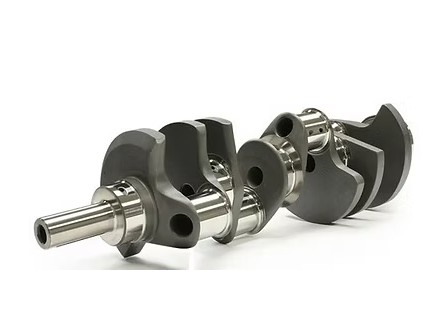
Description
What Is a Compressor Crankshaft?
A crankshaft is the primary rotating mechanical shaft inside the crankcase of a reciprocating compressor.
It receives rotational power from the compressor’s motor or other prime mover and transfers that power through the connecting-rod mechanism to the pistons.
A simplified power transmission arrangement is:
Motor / Prime Mover → Crankshaft → Connecting Rod → Crosshead → Piston Rod → Piston
The crankshaft therefore forms the central mechanical link between the compressor drive and the compression cylinders.
Main Functions of a Crankshaft
1. Converts Rotary Motion to Reciprocating Motion
The crankshaft converts the continuous rotary motion of the drive motor into the back-and-forth movement required by the pistons.
2. Transmits Mechanical Power
It transfers the input power from the compressor drive to the connecting rods and piston assemblies.
3. Supports Crank Pins
Crank pins provide the connection points between the crankshaft and connecting rods.
4. Supports Correct Cylinder Phasing
In multi-cylinder compressors, crankshaft geometry determines the relative movement and timing of the individual pistons.
5. Handles Cyclic Mechanical Loads
The crankshaft is continuously subjected to changing bending, torsional, and reciprocating loads during compressor operation.
Crankshaft Construction
A reciprocating compressor crankshaft may incorporate several precision-machined sections, including:
- Main journals
- Crank pins
- Crank webs
- Counterweights
- Oil passages
- Drive-end connection
- Bearing surfaces
- Keyways or coupling interfaces, where applicable
The exact geometry depends on:
- Number of cylinders
- Cylinder arrangement
- Compressor configuration
- Stroke
- Compressor speed
- Power requirement
- Bearing arrangement
- Drive configuration
- Manufacturer’s original design
Crankshaft Types & Configurations
Aegis Projects can support crankshaft requirements for different reciprocating compressor arrangements, including:
- Single-cylinder compressors
- Multi-cylinder compressors
- Single-stage compressors
- Multi-stage compressors
- Horizontal compressors
- Vertical compressors
- V-type compressors
- W-type compressors
- Opposed-piston compressors
- Oil-free reciprocating compressors
- Lubricated reciprocating compressors
- High-pressure compressors
- Process gas compressors
The crankshaft configuration must match the original compressor geometry and cylinder arrangement.
Main Journals & Crank Pins
Main Journals
Main journals are supported by the compressor’s main bearings and provide the primary rotational support for the crankshaft.
Their dimensional accuracy and surface condition are critical for maintaining:
- Correct bearing clearance
- Proper lubrication
- Shaft alignment
- Stable rotation
- Reduced friction
Crank Pins
Crank pins connect the crankshaft to the connecting rods.
They experience significant cyclic loading and must maintain the specified:
- Diameter
- Roundness
- Surface finish
- Concentricity
- Hardness, where specified
- Fillet geometry
Wear or damage to crank pins can affect connecting-rod operation and overall compressor alignment.
Crankshaft Materials
Crankshaft material selection depends on the compressor design and mechanical loading requirements.
Factors may include:
- Compressor power
- Operating speed
- Cylinder arrangement
- Stroke
- Number of cylinders
- Cyclic loading
- Torsional loads
- Bearing loads
- Operating environment
- Lubrication system
Suitable forged or engineered steel materials may be used according to the original compressor specification.
For replacement applications, the material should be verified against the original engineering requirements rather than selected solely based on physical dimensions.
Crankshaft Surface Finish
The surfaces of the main journals and crank pins require appropriate machining and finishing.
Surface condition can directly affect:
- Bearing performance
- Lubrication
- Friction
- Heat generation
- Wear
- Fatigue resistance
- Component service life
Scoring, pitting, excessive wear, corrosion, or dimensional loss on a journal or crank pin can require repair or replacement depending on the applicable maintenance limits.
Crankshaft Counterweights
Many reciprocating compressor crankshafts incorporate counterweights to help control rotating and reciprocating forces.
Correct counterweight configuration contributes to:
- Dynamic balance
- Reduced vibration
- Stable compressor operation
- Reduced bearing loads
- Reduced mechanical stress
Counterweight geometry and mass distribution must match the original crankshaft design.
Crankshaft Lubrication
Crankshaft bearings and journals typically depend on the compressor crankcase lubrication system.
Depending on the compressor design, lubrication may be supplied through:
- Internal oil passages
- Pressure lubrication
- Oil pump systems
- Splash lubrication
- Other manufacturer-specific arrangements
The lubrication system must provide the required oil supply to the main bearings, crank pins, and other applicable components.
Crankshaft Inspection
During a compressor overhaul, the crankshaft can be inspected for:
- Journal wear
- Crank-pin wear
- Scoring
- Pitting
- Corrosion
- Cracks
- Bending
- Runout
- Surface damage
- Keyway damage
- Oil passage blockage
- Fillet damage
- Counterweight damage
- Dimensional deviation
Appropriate dimensional inspection and non-destructive examination may be performed according to the compressor manufacturer’s maintenance requirements.
Crankshaft Runout & Alignment
Crankshaft alignment and runout are important for reliable operation.
Excessive runout can contribute to:
- Bearing wear
- Connecting rod misalignment
- Increased vibration
- Uneven loading
- Abnormal journal wear
- Mechanical noise
- Reduced compressor reliability
Runout limits should be established from the applicable compressor manufacturer’s specifications rather than generic values.
Signs of Crankshaft Problems
A damaged or excessively worn crankshaft may be associated with:
- Increased compressor vibration
- Abnormal mechanical noise
- Bearing overheating
- Low or unstable oil pressure
- Excessive bearing wear
- Increased crankcase temperature
- Irregular compressor operation
- Metal particles in lubricating oil
- Excessive journal clearance
- Connecting-rod wear
- Abnormal crankcase inspection findings
These symptoms can also originate from bearings, connecting rods, lubrication problems, misalignment, or other mechanical components. Proper inspection is therefore recommended before replacing the crankshaft.
Causes of Crankshaft Failure
Potential contributing factors include:
- Insufficient lubrication
- Contaminated lubricating oil
- Bearing failure
- Excessive mechanical loading
- Misalignment
- Excessive vibration
- Incorrect bearing clearance
- Fatigue cracking
- Corrosion
- Excessive speed
- Improper installation
- Torsional loading
- Manufacturing or machining defects
Identifying the underlying failure mechanism is important before installing a replacement crankshaft.
Crankshaft Replacement
Crankshaft replacement may be required during:
- Major compressor overhaul
- Bearing failure
- Crank-pin damage
- Journal damage
- Fatigue cracking
- Severe wear
- Accident or mechanical failure
- Compressor refurbishment
- Long-term service deterioration
Before replacement, associated components such as main bearings, connecting rods, crank pins, oil passages, seals, and lubrication systems should also be inspected.
Crankshaft Selection Information
For accurate identification of a replacement crankshaft, provide:
| Parameter | Required Information |
|---|---|
| Compressor Make | Manufacturer / Brand |
| Compressor Model | Exact model number |
| Serial Number | Compressor serial number |
| Crankshaft Part Number | Existing part number |
| Compressor Type | Horizontal / vertical / V / W / opposed |
| Number of Cylinders | Total cylinders |
| Cylinder Arrangement | Cylinder configuration |
| Stroke | Compressor stroke |
| Compressor Speed | RPM |
| Drive Power | Motor / prime mover power |
| Main Journal Diameter | Existing dimension |
| Crank Pin Diameter | Existing dimension |
| Main Bearing Arrangement | Bearing configuration |
| Crank Throw | Existing geometry |
| Rotation Direction | As specified |
| Lubrication | Oil lubrication arrangement |
| Material | Existing specification, if known |
| Keyway / Coupling | Drive-end configuration |
| Drawing | Original crankshaft drawing, if available |
Providing the compressor make, model, serial number, crankshaft part number, photographs, dimensions, and original drawings can help identify the correct replacement.
Crankshaft Repair & Reconditioning
Depending on the condition and applicable manufacturer limits, crankshafts may sometimes be evaluated for reconditioning rather than complete replacement.
Possible inspection or repair activities may include:
- Journal dimensional inspection
- Crank-pin inspection
- Surface inspection
- Runout measurement
- Crack detection
- Oil passage inspection
- Journal polishing where permissible
- Controlled grinding where engineering limits allow
- Dimensional restoration
- Balance verification
Any repair should be performed only when the resulting dimensions, material condition, balance, and mechanical integrity remain within the applicable compressor specifications.
Applications
Replacement crankshafts are used in reciprocating compressor systems for:
- Natural Gas Compression
- CNG Compression
- Hydrogen Compression
- Industrial Air Compression
- Process Gas Compression
- Hydrocarbon Gas Compression
- Oil & Gas
- Chemical Processing
- Petrochemical
- Refineries
- Gas Processing
- Gas Storage
- Power Generation
- Industrial Manufacturing
Related Reciprocating Compressor Spare Parts
Aegis Projects can also support associated components including:
- Cylinders
- Pistons
- Piston Rods
- Piston Rings
- Rider Rings
- Distance Pieces
- Rod Packing
- Tangent Rings
- Radial Rings
- Pressure Breaker Rings
- Backup Rings
- Packing Cases
- Oil Scraper Rings
- Crossheads
- Crosshead Shoes
- Connecting Rods
- Main Bearings
- Crank Pin Bearings
- Cylinder Valves
- Valve Plates
- Valve Springs
- Gaskets
- Seals
- Intercoolers
- Aftercoolers
- Pulsation Dampeners
- Lubrication Components
Aegis Projects – Reciprocating Compressor Crankshafts
Aegis Projects Technology Pvt. Ltd. supplies replacement crankshafts and reciprocating compressor spare parts for industrial compressor maintenance, overhaul, refurbishment, and replacement requirements.
Crankshaft requirements can be supported using OEM part numbers, compressor make and model, serial number, original drawings, crankshaft dimensions, photographs, samples, and operating information.
Because the crankshaft is a highly loaded rotating component, replacement selection should consider the complete compressor configuration, including stroke, cylinder arrangement, crank geometry, bearing arrangement, speed, drive power, lubrication, and balance requirements.
For critical compressor applications, dimensional inspection, material verification, balance checks, and appropriate quality inspection should be completed according to the applicable compressor engineering specification.
Contact Aegis Projects Technology for reciprocating compressor crankshafts, crankshaft components, compressor spare parts, and application-specific technical assistance.